The Short Answer
Taobao is for testing cheap, low-commitment units straight from Chinese sellers. Once a shipping agent is set up, it's the lowest-cost way to buy one or a handful of units of almost anything, including niche products that never make it onto an export-facing platform. Alibaba is for sourcing in bulk once a product is proven. It connects buyers directly with English-speaking, export-ready factories, and Trade Assurance covers qualifying orders the way neither Taobao nor Shopee can. Shopee isn't a sourcing platform at all. It's the storefront where the sourced product finally gets sold to a Filipino customer, with GCash and Maya checkout and the local delivery network that a reseller's own buyers expect.
None of the three competes with the others for the same job. A reseller who treats them as a sequence, test on Taobao, scale on Alibaba, sell on Shopee, is working the platforms the way they're actually built, instead of trying to force one to do all three jobs at once.
At a Glance: Taobao vs Alibaba vs Shopee for Resellers
Here's how the three actually differ once you're sourcing to resell, not just shopping for yourself.
| Factor | Taobao | Alibaba | Shopee |
|---|---|---|---|
| Role in reseller workflow | Sourcing, test units | Sourcing, bulk restock | Selling, the storefront |
| Platform language | Mandarin, needs an agent | English, export-ready | English/Filipino |
| Minimum order quantity | Usually none | Supplier-set, 1-100+ | None, retail checkout |
| Pricing level | Lowest, domestic China price | Factory price, volume-based | Local retail price |
| Shipping to PH | Via agent, 2-4 weeks | Freight/air, negotiated | Local courier, 2-7 days |
| Buyer protection | Depends on the agent | Trade Assurance on qualifying orders | Platform-backed, end-customer side |
| Payment | Via agent, usually peso top-up | Card, bank transfer, escrow | GCash, Maya, card |
Where Taobao Wins
The lowest price per unit anywhere in the funnel. Taobao is a domestic Chinese marketplace, which means sellers are pricing for the local market, not for export markup. For a reseller testing whether a product is even worth stocking, that price gap often makes the difference between a test batch that's affordable to risk and one that isn't.
The widest catalog of niche and hyper-specific items. Because Taobao serves hundreds of millions of domestic shoppers, its catalog goes far deeper into niche categories than either Alibaba or Shopee, products a reseller would struggle to find anywhere else, from obscure hobbyist parts to trend-specific items that haven't reached export platforms yet.
Low commitment, fast iteration. Most Taobao sellers carry no minimum order quantity, so a reseller can order one or two of a dozen different products in a single week to see what resonates, something that's slow and expensive to replicate through supplier-by-supplier Alibaba negotiations. The tradeoff is that nearly every purchase needs a shipping agent to translate, consolidate, and forward orders to the Philippines, since the platform itself isn't built for direct international checkout.
Where Alibaba Wins
Factory-direct pricing once volume justifies it. Alibaba connects resellers straight to manufacturers built for export, and the per-unit price drops sharply once an order clears a supplier's minimum order quantity. For a product that's already proven itself on a smaller test batch, this is where the real margin on a reseller's stock gets built.
Custom branding and packaging. Alibaba suppliers are typically open to private labeling, custom packaging, or a logo printed directly on the product, options that neither Taobao's domestic listings nor Shopee's fixed retail catalog support. For a reseller moving from flipping generic items to building an actual brand, this is the stage where that shift happens.
Trade Assurance and negotiated terms. Because bulk orders carry more money at risk per transaction than a Taobao test batch, Alibaba's Trade Assurance program matters more here, covering qualifying orders paid through the platform's own checkout against late delivery or quality that doesn't match the agreed terms. Pricing and shipping terms are also negotiable directly with the supplier, something neither Taobao nor Shopee's fixed listings allow. For a side-by-side look at how Alibaba stacks up against other sourcing platforms more broadly, see the Alibaba vs AliExpress vs Temu breakdown.
Where Shopee Wins
The actual storefront Filipino buyers trust. Shopee isn't where a reseller sources stock, it's where that stock finally reaches a paying customer. Local buyers already know how to navigate it, trust its checkout, and expect GCash, Maya, or card payment to just work, none of which a reseller has to build or explain from scratch.
Local delivery speed that closes sales. Once sourced stock has landed in the Philippines, Shopee's courier network gets it into a buyer's hands in days rather than weeks, which matters enormously for closing a sale versus losing it to a competitor whose listing promises faster delivery.
Built-in discovery and trust signals. Shop ratings, review counts, and Shopee's voucher and flash-deal system all help a new reseller's storefront get discovered without needing to drive outside traffic from day one, something neither Taobao nor Alibaba offer since both are sourcing-side platforms with no local retail audience to tap into.
The Reseller Workflow: Source, Scale, Sell
The realistic path most Filipino resellers end up on isn't picking one platform, it's moving through all three in sequence as a product proves itself:
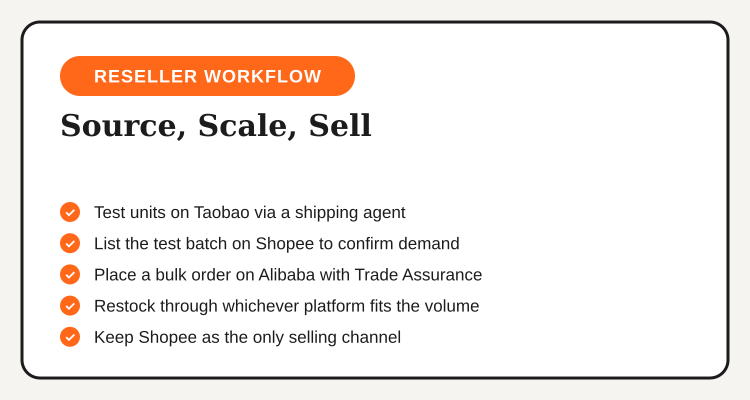
- Test on Taobao first. Order a small batch through a shipping agent at the lowest possible unit cost, confirm build quality, and check whether the product actually photographs and sells before risking real capital on it.
- List the test batch on Shopee. Put the small batch up for sale to see real local demand, not guessed demand, before committing to a bulk order.
- Move to Alibaba once demand is confirmed. Place a factory-direct bulk order with Trade Assurance covering the transaction, negotiating unit price and possibly custom packaging now that the product has proven itself.
- Restock through whichever platform fits the volume. Smaller top-ups of fast-moving niche items can still go through Taobao; larger, steady-selling SKUs move to Alibaba for the better per-unit economics.
- Keep Shopee as the only selling channel in this chain. Neither Taobao nor Alibaba should ever be treated as somewhere to resell stock, both are sourcing-side platforms built for buyers, not for running a Filipino storefront.
Shipping, Payment & Buyer Protection Compared
Taobao purchases route through a shipping agent rather than direct international checkout, which means both cost and protection depend heavily on which agent a reseller picks. Most agents consolidate orders into one shipment and forward it to the Philippines in roughly 2 to 4 weeks, with payment usually handled through a peso top-up into the agent's own account rather than a card transaction on Taobao itself.
Alibaba shipping scales with order size, small sample orders can move by air parcel in a few weeks, while full bulk orders typically go by sea or air freight arranged directly with the supplier or a freight forwarder, with timelines negotiated per shipment. Orders paid through the platform's own checkout keep Trade Assurance coverage intact, while bank transfers arranged outside that checkout lose it, so first-time buyers should stay inside the covered flow until a supplier relationship is established.
Shopee is the most predictable of the three because it's a domestic transaction, not an import. Local courier delivery typically lands in 2 to 7 days depending on the buyer's location, GCash, Maya, and card payments all work natively at checkout, and platform-backed buyer protection covers the end customer, the person actually receiving the reseller's product, start to finish.
Active Taobao, Alibaba & Shopee PH Deals
Whether sourcing a test batch, placing a bulk order, or setting up a storefront, the brand pages below are updated regularly with active deals for each platform.
| Platform | Best For | Updated | |
|---|---|---|---|
| Taobao Philippines | Small-batch sourcing and testing | Weekly | View Deals → |
| Alibaba Philippines | Bulk and wholesale sourcing | Weekly | View Deals → |
| Shopee Philippines | Selling to Filipino buyers | Weekly | View Deals → |
Frequently Asked Questions
Updated weekly, sourcing deals for test batches and bulk orders, plus storefront vouchers for selling on Shopee, in one place.
View Shopee Deals →