The Short Answer
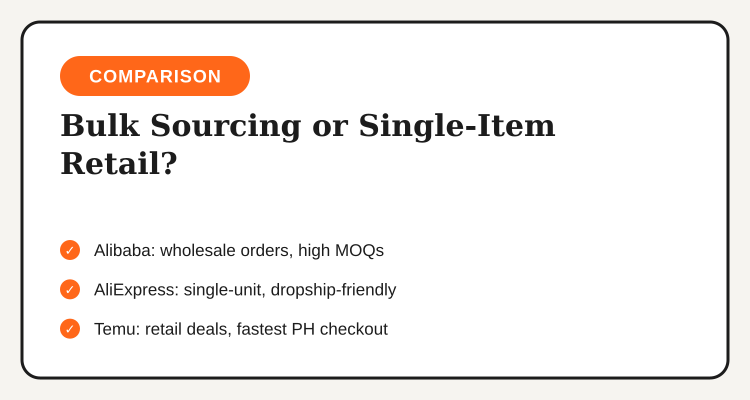
Alibaba is for bulk and wholesale sourcing. If you're a reseller, a small business owner, or anyone ordering dozens or hundreds of units of the same item straight from a factory, Alibaba's supplier network and negotiated pricing make it the cheapest route per unit, once you clear the minimum order quantity. AliExpress is the single-unit version of that same supplier base. It's where Filipino dropshippers and product testers buy one or a handful of units before committing to a bulk Alibaba order. Temu is built for everyday retail shopping, one item at a time, with the fastest PH checkout, GCash and Maya support, and the deepest app-wide coupon stacking of the three.
The platform that fits isn't about which one is "best," it's about order size and buying intent. A reseller sourcing 200 phone cases to flip on Shopee needs Alibaba. Someone testing whether that same phone case sells before committing needs AliExpress. Someone who just wants one phone case for their own phone needs Temu.
At a Glance: Alibaba vs AliExpress vs Temu Philippines
Here's the side-by-side breakdown of what actually separates the three platforms for a Filipino buyer.
| Factor | Alibaba | AliExpress | Temu |
|---|---|---|---|
| Order type | Bulk, wholesale | Single-unit, small batch | Retail, single units |
| Minimum order quantity | Often set by supplier, 1-100+ | None | None |
| Pricing model | Factory price, often negotiable | Fixed listing price | Fixed, heavily discounted retail |
| Best for | Resellers, business owners | Dropshippers, product testers | Everyday Filipino shoppers |
| Shipping to PH | Freight/sea or air cargo, negotiated | Standard parcel, 10-20 days | 7-15 days, most predictable |
| Buyer protection | Trade Assurance on qualifying orders | Buyer protection, dispute window | 90-day returns, first return free |
| Payment options | Card, bank transfer, escrow | Card, GCash, Maya | GCash, Maya, Visa/Mastercard |
| Discount style | Negotiated, volume-based | Store coupons, flash deals | Aggressive app-wide + search-bar codes |
Where Alibaba Wins
Bulk sourcing at factory pricing. Alibaba connects buyers directly with manufacturers, which means the per-unit price drops sharply once an order clears the supplier's minimum order quantity. For a Filipino reseller planning to list 100+ units of the same product on Shopee, Lazada, or a physical stall, Alibaba's factory-direct pricing beats anything available on a retail platform, often by 50% or more once volume is high enough.
Custom specs, packaging, and private labeling. Most Alibaba suppliers are open to customization requests, your own branding on the packaging, a specific color run, a logo printed on the product itself, something neither AliExpress nor Temu's listings support since those are fixed, pre-made SKUs. This matters for anyone building their own small brand rather than just reselling a generic item.
Negotiated terms and Trade Assurance. Pricing on Alibaba is rarely fixed the way it is on a retail app, buyers can message suppliers directly to negotiate unit price, payment terms, and shipping method. Orders paid through Alibaba's official checkout and covered by Trade Assurance add a layer of protection against late delivery or quality mismatches, which matters more here than on AliExpress or Temu since bulk orders carry more money at risk per transaction.
Where AliExpress Wins
Testing a product before committing to a bulk order. AliExpress pulls from the same supplier base as Alibaba but strips out the minimum order quantity. For a reseller who isn't sure a product will actually sell, ordering one or two units on AliExpress first, checking the real build quality, photographing it for a listing, is the lower-risk move before placing a 200-unit Alibaba order with a supplier you haven't tested.
Dropshipping without holding inventory. AliExpress remains the backbone of small-scale dropshipping for Filipino sellers who list a product online and only order from the supplier once a customer pays. There's no upfront bulk commitment, no warehouse space needed, and the fixed per-unit listing price makes margin math straightforward compared to negotiating with an Alibaba supplier directly.
A wider single-unit catalog than Temu for niche items. AliExpress's supplier base is enormous and skews toward more specialized, niche, or hobbyist products than Temu's more mainstream-consumer catalog. For sourcing a specific component, an obscure accessory, or a product category Temu simply doesn't stock, AliExpress is usually the better search.
Where Temu Wins
Retail convenience and the fastest Philippine checkout. Temu is built around the individual Filipino shopper buying one item for personal use, not a business sourcing inventory. GCash and Maya both work natively at checkout, delivery timelines are the most predictable of the three, and the whole flow, browse, buy, track, is designed for someone who wants a product in their hands, not a supplier relationship.
The deepest coupon stacking for a single order. Temu's signature move is search-bar promo codes layered on top of new-user bundles and sitewide vouchers, which on a first order can push the effective discount well past what a one-off AliExpress listing or a small Alibaba sample order would ever offer. For a one-time personal purchase, that stacking usually beats both competitors on headline price.
No MOQ pressure, no supplier vetting. Buying on Alibaba means evaluating a supplier's reliability, response time, and review history before committing to a bulk payment. Temu removes that entirely, every listing is platform-managed, buyer protection is standardized, and there's no negotiation required. For someone who just wants a product without becoming a part-time procurement manager, that simplicity is the real value.
Bulk vs Retail: Matching the Platform to Your Buying Goal
The real decision between these three platforms comes down to why you're ordering, not which one has the lowest sticker price on a single listing. A few common scenarios for Filipino buyers and small resellers:
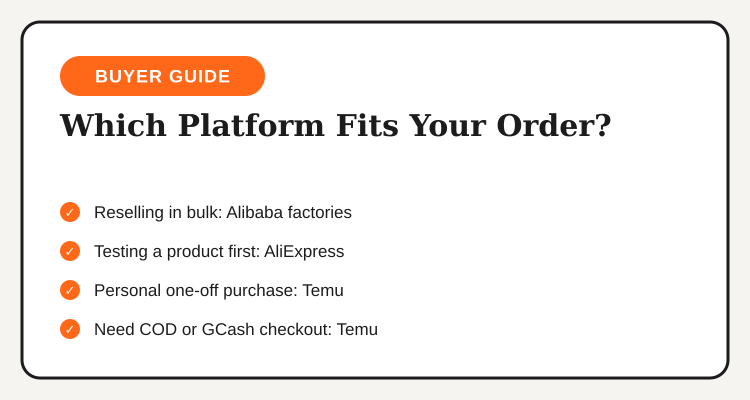
- Reselling 50+ units of the same product. Go straight to Alibaba. Once you clear a supplier's minimum order quantity, the per-unit cost drops below anything AliExpress or Temu can offer, and you can negotiate packaging or branding on top.
- Not sure if a product will sell yet. Order 1-3 units on AliExpress first. Confirm quality, photograph it, test demand with a small listing, then move to Alibaba for the bulk order once you've validated it.
- Dropshipping with no inventory held. Stay on AliExpress. The fixed per-unit price and no-MOQ structure make margin math predictable without committing capital to stock.
- Buying one item for personal use. Temu almost always wins here, fastest checkout, GCash/Maya support, and the deepest first-order coupon stacking of the three.
- Need it fast and don't want to manage a supplier relationship. Temu's platform-managed buyer protection and predictable delivery window remove the supplier-vetting step entirely.
The platforms aren't really competitors, they're different stages of the same sourcing funnel. A Filipino small business owner might realistically use all three: AliExpress to test a product, Alibaba to scale it once it sells, and Temu for anything they're buying for themselves along the way. For a wider marketplace comparison beyond these three, the Shopee vs Lazada Philippines guide covers the local retail side of that same funnel.
Shipping, Payment & Buyer Protection Compared
Alibaba shipping is the most variable of the three because it scales with order size. Small sample orders can ship by standard air parcel in roughly 2-3 weeks, while full bulk orders are typically moved by sea or air freight, arranged directly with the supplier or through a freight forwarder, and timelines are negotiated per shipment rather than fixed. Payment is usually handled through the platform's checkout for Trade Assurance coverage, or by bank transfer for larger negotiated orders, placing more responsibility on the buyer to vet the supplier upfront.
AliExpress ships via standard international parcel, generally landing in the Philippines in 10 to 20 days depending on the seller and shipping method chosen at checkout. Card payments, GCash, and Maya are all supported, and the platform's buyer protection covers a defined dispute window if an item doesn't arrive or doesn't match the listing.
Temu is the most consistent of the three, typically 7 to 15 days to most Philippine addresses, with GCash, Maya, and Visa/Mastercard all working smoothly at checkout. Temu's 90-day return policy with a free first return gives individual buyers the most forgiving return path of the three platforms, which matters more for a single personal purchase than for a bulk order already committed to resale.
Active Alibaba, AliExpress & Temu PH Codes Right Now
The brand pages below are updated regularly with active deals for each platform, whether you're sourcing in bulk or buying a single item.
| Platform | Best For | Updated | |
|---|---|---|---|
| Alibaba Philippines | Bulk and wholesale sourcing | Weekly | View Deals → |
| AliExpress Philippines | Single-unit sourcing, dropshipping | Weekly | View Deals → |
| Temu Philippines | Everyday retail shopping | Weekly | View Deals → |
Frequently Asked Questions
Updated weekly, bulk sourcing deals, single-unit discounts, and retail vouchers for all three platforms, in one place.
View Temu Deals →