Same Parent Company, Two Very Different Apps
The confusion is understandable: both names trace back to the same company, PDD Holdings Inc., a Nasdaq-listed Chinese internet company. But Pinduoduo and Temu were built for different jobs. Pinduoduo launched in 2015 as a China-only social commerce app, built around a group-buying mechanic called pin-tuan, where a listed price drops once enough friends or strangers join the same order within a countdown window. It grew explosively in China's lower-tier and rural cities, in part by leaning hard into agricultural produce, connecting farmers directly to urban buyers and cutting out layers of wholesale middlemen.
Temu launched in September 2022, headquartered out of Boston, as PDD Holdings' answer to a much bigger question: how do you take the same factory-direct sourcing advantage and sell it to shoppers who aren't in China, don't read Mandarin, and don't have a Chinese bank card? Temu strips out most of Pinduoduo's social-gaming layer and swaps it for a more familiar fixed-price checkout, backed by an enormous global paid-advertising budget. Temu Philippines is the version of that answer Filipino shoppers actually see.
Pinduoduo vs Temu: Key Company Data
| Metric | Pinduoduo | Temu |
|---|---|---|
| Parent company | PDD Holdings Inc. (Nasdaq: PDD) | |
| Founded | 2015 | September 2022 |
| Founder | Colin Huang | Launched under PDD Holdings, no separate named founder |
| Headquarters | Shanghai, China | Boston, Massachusetts, USA |
| Primary market | Mainland China (domestic) | United States, Europe, Southeast Asia, and 70+ other countries |
| PDD Holdings market cap | Roughly $113 billion (September 2026) | |
| PDD Holdings trailing 12-month revenue | Roughly $64.4 billion (mid-2026) | |
| Employees (PDD Holdings group) | Roughly 17,000+ | |
| Core mechanic | Pin-tuan (team) group buying | Fixed-price, solo checkout |
PDD Holdings does not break out Pinduoduo and Temu revenue separately in public filings; the company-level figures above cover both platforms combined.
How Each Platform Actually Works
On Pinduoduo, browsing feels closer to a social feed than a search engine. Almost every listing nudges you to share it with a group chat or invite friends to "team up" for a lower price, and mini-games, daily check-ins, and referral rewards are baked into the home screen rather than bolted on as an afterthought. It's shopping designed to be a shared activity, not a solo errand.
Temu keeps the factory-direct pricing but drops most of that social layer. You browse a familiar grid of products, prices are fixed the moment you add to cart, and the "engagement" mechanics that remain, spin-to-win coupons, countdown flash deals, free-gift referral programs, run closer to a conventional e-commerce loyalty gimmick than a genuine group-buying system. Our own breakdown of Temu's free gift program covers exactly how that referral mechanic works in practice.
Pricing: Who's Actually Cheaper
| Factor | Pinduoduo | Temu |
|---|---|---|
| Typical unit price | Lower on identical items | Slightly higher, absorbs import/cross-border costs |
| Why prices differ | Domestic China order, one less logistics layer | Cross-border shipping, customs, and returns infrastructure priced in |
| Discount mechanic | Group price drops as more people join | Flat discounts, flash sales, first-order coupons |
| Minimum order | None, but group deals need enough participants | None |
| New-user incentive | Referral bonuses, group-invite credits | Steep first-order percentage-off, often 80-90% |
Early Filipino users comparing the two directly have echoed this: one Reddit poster's blunt assessment after testing Pinduoduo against Shopee was that "the selection and prices in PinDuoDuo are much better," a gap that, based on early comparisons, extends to Temu as well on a lot of overlapping categories, though the difference is narrower since Temu's pricing already undercuts most local marketplaces on its own. If you're deciding between Temu and other cross-border options specifically, our AliExpress vs Temu breakdown and Temu vs SHEIN vs TikTok Shop comparison go deeper on where Temu itself lands against other cross-border marketplaces.
Supply Chain and Sourcing
Both platforms pull from the same underlying advantage: direct access to China's manufacturing base, cutting out the layers of distributors, brand markups, and regional warehousing that traditional retailers and even Shopee or Lazada sellers still work through to some degree. Pinduoduo's version of this leans heavily into agriculture, its original growth engine connected small farmers straight to urban Chinese consumers, alongside its broader consumer-goods catalog. Temu applies the same direct-factory model to a global, English-language storefront, with PDD Holdings' logistics network handling customs, international freight, and last-mile delivery in each destination market on the seller's behalf, something an individual Chinese factory could never manage alone.
The tradeoff for both platforms is quality consistency. Neither is built around a curated, quality-first catalog, they're built around volume and price, so outcomes vary a lot seller to seller and item to item, more than they would on a platform that vets suppliers more tightly.
Shipping and Delivery to the Philippines
| Pinduoduo | Temu | |
|---|---|---|
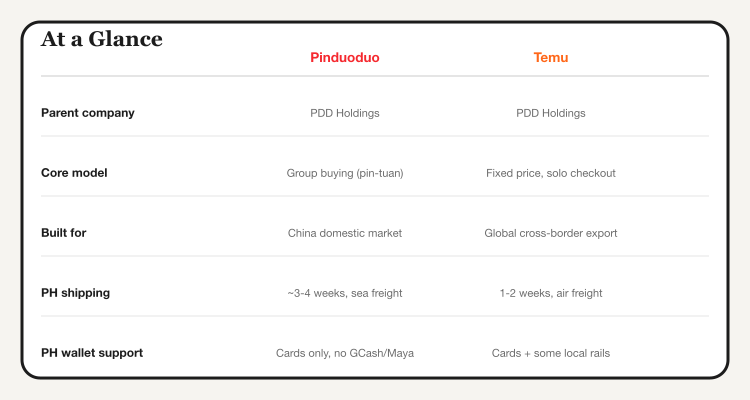
| Typical delivery time (PH) | ~3-4 weeks, mostly sea freight | ~1-2 weeks, mostly air freight |
| Official PH support | None, English interface via en.pinduoduo.com only | Yes, official app and site serve the Philippines directly |
| Tracking | Basic, less granular for cross-border orders | Detailed, integrated tracking through delivery |
| Local payment rails | International cards only, no GCash/Maya | Cards, plus broader local payment support |
Our own reporting on early Philippine Pinduoduo users found shipping running "free shipping but slow as a snail," close to a month to Cebu and slightly faster to Manila, since most orders travel by sea rather than air. Temu's logistics network, purpose-built for cross-border delivery from day one, consistently runs faster, our own Temu shipping and delivery guide and Temu payment methods guide cover exactly what to expect order to order.
Shopping Experience and App Design
Pinduoduo's interface is unapologetically maximalist, dense grids, countdown timers, spinning wheel games, and constant prompts to share or invite, closer in spirit to a mobile game with a shopping cart attached. It rewards spending time in the app and inviting others in, which is precisely the point: virality is the growth engine, not just a feature.
Temu keeps a lot of that gamified DNA, spin-to-win wheels and countdown flash sales are still very much present, but the core browsing and checkout flow reads closer to Shopee or AliExpress: familiar categories, a standard cart and checkout, and English throughout. For a first-time Filipino shopper, that familiarity is a real advantage over Pinduoduo's steeper, China-first learning curve.
Reviews: What Shoppers Are Actually Saying
A Reddit thread in r/Antiscamph captured the hesitation a lot of Filipino shoppers feel about Pinduoduo specifically: one poster said they were "apprehensive on downloading this apk" after researching "a history of malware on their app in other countries," a reasonable reaction given Pinduoduo has no official Play Store listing in most markets outside China. Our full Pinduoduo Philippines opinion piece covers that thread and the wider safety conversation in more depth.
Temu's review pattern looks different: it's an officially listed, widely used app, so the complaints center less on trust in the platform itself and more on individual order outcomes, inconsistent product quality, sizing that doesn't match the listing, and the occasional slow refund. That's a normal profile for any high-volume, low-cost marketplace rather than a red flag specific to Temu, and it mirrors complaints leveled at Shein and AliExpress just as often. Our Is Temu legit in the Philippines guide breaks down that safety question specifically for Temu.
Marketing Strategy and Target Market
Pinduoduo's marketing was never built around ad spend alone, it was built around social proof and word of mouth. Group-buy invites double as free distribution: every shared purchase link is a small advertisement sent by a friend rather than a brand. That mechanic was specifically aimed at China's lower-tier and rural cities, areas that make up over half the country's population and were historically underserved by Alibaba's more first-tier-city-focused platforms. Roughly two-thirds of Pinduoduo's user base comes from third-tier cities and beyond, a deliberate target market choice, not an accident of growth.
Temu flips that playbook almost entirely: heavy, direct paid advertising rather than social virality. Its "Shop Like a Billionaire" Super Bowl campaign, which aired the same 30-second spot five times during Super Bowl LVIII, is the clearest example, a $9.99-and-under bargain hunt framed as affordable luxury, aimed at price-conscious shoppers broadly, not any one demographic. The ad campaign was followed by a documented 45% spike in app downloads, and Temu has kept up aggressive paid-acquisition spending, app install ads, first-order discount codes, and affiliate and referral programs, ever since, a fundamentally different growth engine than Pinduoduo's word-of-mouth model.
That difference in target market carries through to the Philippines directly: Temu is actively marketing to Filipino shoppers, running promo codes and affiliate partnerships (TipidNation's own Temu Philippines promo code page is one example), while Pinduoduo has made no equivalent official push here, its Philippine presence so far is organic curiosity spilling over from its Chinese growth, not a deliberate market entry.
Other Cross-Border Platforms Worth Knowing
Pinduoduo and Temu aren't the only factory-direct options Filipino shoppers compare. AliExpress, Alibaba's international consumer marketplace, predates both and remains a broader, less price-obsessed alternative with a more established seller-rating system. SHEIN runs a similar factory-direct playbook but narrows its focus almost entirely to fast fashion. TikTok Shop takes a different distribution angle entirely, selling through short-video and livestream commerce rather than a traditional storefront. For everyday Philippine essentials with same-week delivery, Shopee and Lazada remain the more dependable fallback whenever speed matters more than the rock-bottom price. Our Shopee vs Lazada comparison and Temu vs SHEIN vs TikTok Shop breakdown cover those alternatives in full.
Which One Is Better for Filipino Shoppers?
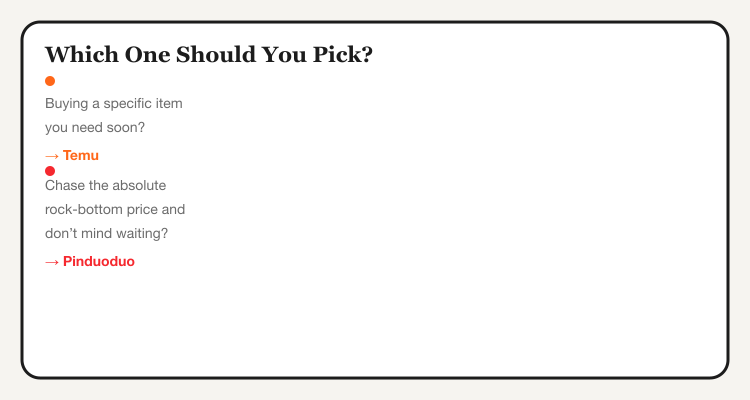
There isn't a single winner, there's a better fit depending on what you're optimizing for. Temu is the more practical choice for almost every Filipino shopper today: it's officially supported here, checkout and support run in English, delivery is faster, and years of local order volume back up its track record. If you want factory-direct pricing without extra risk, Temu is the one to actually use.
Pinduoduo is worth understanding, not necessarily worth using yet. Its prices and selection can genuinely beat Temu on identical items, but that advantage comes bundled with a China-first app experience, no official Play Store listing in most regions outside China, no GCash or Maya support, and a month-long wait for anything shipped by sea. Treat it as a platform to watch rather than one to rely on for anything you need soon.
And for either platform: anything you need within the week still belongs on Shopee or Lazada, whose local warehousing solves a problem neither Pinduoduo nor Temu is built to solve.
Frequently Asked Questions
Sources: Pinduoduo, Wikipedia, PDD Holdings' SEC Form 20-F annual filings, CNN Business on Temu's Super Bowl campaign, Dao Insights on Pinduoduo's group-buying model, and Reddit threads on r/Antiscamph and r/ShopeePH referenced in our own Pinduoduo Philippines coverage. Figures current as of September 2026; always confirm current pricing and availability directly in each app.
Get more Pinduoduo Philippines codes, promos, and finds shared by fellow PDD shoppers in the Pinduoduo Philippines Facebook Group. For coupon code guides, redemption tips, and hacks for Pinduoduo worldwide, join the Pinduoduo Coupons Facebook Group.
Join Pinduoduo Philippines Group →See current Temu promo codes before you compare it against Pinduoduo, or browse other cross-border shopping options.
View Temu Deals → View Pinduoduo Deals →