What ProtonVPN's Free Plan Actually Includes
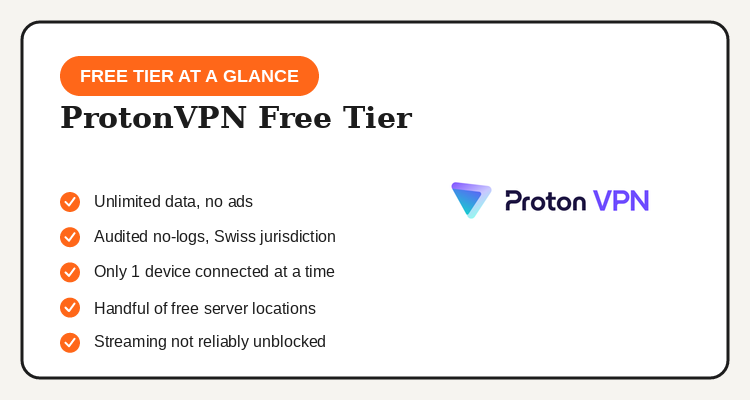
Most free VPN apps hook you with a data cap, a few gigabytes a month, then push you to upgrade once you hit it. ProtonVPN takes a different approach: the free plan has no data limit at all, no ads, and no credit card required to sign up. That alone makes it one of the more genuinely usable free options in a category where "free" often means "barely functional."
The trade-off is server choice, not usage. Free accounts connect to a small handful of server locations rather than the full Plus network, and only one device can stay connected at a time. ProtonVPN is built by the same team behind Proton Mail, based in Switzerland, and runs on an audited, no-logs privacy policy that applies to free and paid users alike. For anyone whose main goal is basic encryption on public Wi-Fi or keeping an ISP from seeing browsing activity, that foundation matters more than server count.
It's also worth noting what free users don't lose access to. Core security features, a kill switch that blocks internet traffic if the connection drops, and support for the modern WireGuard protocol, aren't locked behind Plus. ProtonVPN's approach treats free users as full customers of the privacy tools, just with a smaller server menu, which is a different philosophy from VPNs that strip out security features entirely on their free plan.
Using It Day to Day: Speed and Server Access
In daily use, ProtonVPN free handles browsing, messaging apps, and general web traffic without much friction. Connection setup is quick through the desktop and mobile apps, and the WireGuard protocol keeps latency reasonable for a free service. Where it gets noticeably slower is during peak local hours, since free users share a smaller pool of servers with everyone else on the free tier, unlike Plus subscribers who get priority routing.
The bigger limitation shows up when you need a specific country. With only a few free server locations available, you can't pick and choose the way you could on a paid plan. If your use case is simple, encrypting a coffee shop connection or hiding your IP from casual tracking, that's rarely a problem. If you need a server in a particular region for work or research, it can be.
What Changes Once You Turn ProtonVPN Free On
- Your ISP can no longer see which sites you visit
- Public Wi-Fi traffic (cafes, airports, malls) gets encrypted
- Your visible IP address switches to one of the free server locations
- Speed dips slightly during high-traffic hours, more noticeably than on Plus
- You're limited to one connected device until you upgrade
Where the free plan earns its keep, and where it starts to show its limits
Free vs. Plus: Where the Line Actually Sits
On paper, the jump from free to Plus looks like a lot of new features. In practice, most of it comes down to three things: server access, device count, and streaming reliability.
| Feature | Free | Plus |
|---|---|---|
| Data Allowance | Unlimited | Unlimited |
| Server Locations | A handful of free locations | Thousands of servers, 90+ countries |
| Devices at Once | 1 | Up to 10 |
| Streaming Access | Not reliable | Works with most major platforms |
| Speed Priority | Standard, shared servers | Higher-capacity Plus servers |
None of that makes the free plan a bad option, it makes it a specific one. It's built for people who want solid encryption on one device without paying anything. The moment your needs grow past that (multiple devices, streaming, a specific server location), Plus is doing a genuinely different job, not just removing an artificial cap. Timing an upgrade around a ProtonVPN Philippines promo code for September 2026 is the easiest way to soften that jump in price.
Where the Free Tier Falls Short
Three situations expose the free plan's limits fastest. Streaming is the biggest one: platforms actively detect and block VPN traffic, and a small, publicly known set of free server addresses gets flagged far sooner than a large rotating network. Second, torrenting and P2P traffic aren't supported on ProtonVPN's free servers at all, that's a Plus-only capability. Third, households sharing one VPN account across a phone, a laptop, and a smart TV will hit the single-device wall almost immediately.
None of these are flaws exactly, they're the boundary that makes a genuinely free, unlimited-data plan sustainable for ProtonVPN to offer in the first place. Knowing which side of that boundary your own habits fall on is really the whole decision.
Switching servers also takes a bit more patience on the free plan. Because there are only a few free locations to begin with, you can't hop to a fresh server the moment one feels congested the way a Plus user can pick from a much larger pool. For light, occasional use that rarely matters, for anyone connecting daily during peak evening hours, it's the kind of small friction that adds up over weeks of use.
A quick checklist before you decide whether to pay for Plus
Your 5-Step Guide to Trying ProtonVPN Free
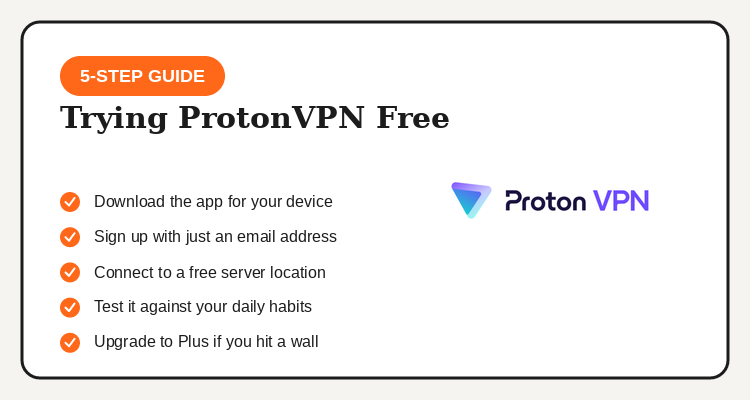
- Download the app for your device. ProtonVPN supports Windows, macOS, iOS, Android, and Linux.
- Sign up with just an email address. No credit card or phone number needed for the free plan.
- Connect to one of the free server locations. Pick whichever gives you the best speed for your area.
- Test it against your actual habits for a week. Browsing, messaging, and basic privacy use are the free tier's strong suit.
- Upgrade to Plus if you hit a wall. Apply your discount code at checkout if streaming, multiple devices, or a specific server location becomes a dealbreaker.
Who Should Stick With Free, and Who Should Upgrade
If you're a single user who mostly needs encrypted browsing on one device, occasional public Wi-Fi protection, and peace of mind about ISP tracking, ProtonVPN's free plan genuinely covers that without asking you to pay a peso. It's also a smart way to test Proton's apps and interface before committing to a subscription.
If you regularly stream from multiple platforms, need more than one device connected at once, or want a server in a specific country, the free tier will start to feel restrictive fast. At that point, either ProtonVPN Plus or a competitor built specifically around streaming speed, like NordVPN Philippines deals, is worth comparing before you decide where to spend.
Families and shared households sit in a slightly different spot. Even if any one person's usage is light, several people trying to use the same free ProtonVPN account across separate phones and laptops will keep bumping into the single-device limit throughout the day. In that situation, the cost of a Plus plan is really the cost of covering everyone at once, which tends to work out cheaper per device than it first looks once you count how many gadgets are actually competing for that one free connection slot.
Bottom Line
ProtonVPN's free plan isn't a stripped-down trial designed to frustrate you into paying, it's a real, unlimited-data VPN with a genuinely small set of restrictions: fewer servers, one device, and no reliable streaming. For plenty of everyday use cases, that's a fair trade for zero cost.
Where it stops being enough is the exact point where an upgrade to Plus starts making sense, more devices, more locations, and actual streaming support. Watching for an active ProtonVPN discount for September 2026 is the difference between paying full price for that jump and catching it on sale.
See all active ProtonVPN promo codes
Plan discounts, bundle pricing, and welcome offers, updated regularly on the ProtonVPN Philippines deals page.
View ProtonVPN Deals →