
The Ad Blitz Filipinos Are Noticing
A Reddit thread on r/Antiscamph put the feeling plainly: a sudden surge of Pinduoduo advertising, then a search for the app that turns up nothing on the Play Store, only a direct APK download from Pinduoduo's own website. The poster's exact concern is worth quoting: they were "apprehensive on downloading this apk" after finding "a history of malware on their app in other countries." That's not paranoia, it's a reasonable reaction to a well-documented pattern, several markets have flagged security issues tied to sideloaded versions of the app in the past, and skipping the Play Store means skipping Google's built-in scanning layer entirely.
We're not going to tell you the app is definitely unsafe, we don't have evidence of a Philippine-specific incident. But the absence of an official Play Store listing, this deep into Pinduoduo's international expansion, is itself a data point worth sitting with before you sideload anything, financial apps or shopping apps handling your card details especially.
What Actually Makes Pinduoduo Different From Shopee
Pinduoduo's core mechanic is pin-tuan, group buying that drops the price once enough people join a purchase within a countdown window. It turns ordinary shopping into something closer to a game, urgency and social coordination baked into the checkout flow itself, rather than a straightforward add-to-cart. Layered on top of that is a business model built on sourcing more directly from Chinese factories, cutting out layers of distributors and warehousing that even Temu and Shopee sellers still work through to varying degrees.
That combination is genuinely why prices run lower, not a marketing trick. Analysts covering the platform have noted that its price-driven growth model has already worked so well in more mature markets that it's started reshaping how premium and luxury brands market themselves too, leaning into gamified loyalty mechanics, limited drops, reward ladders, rather than the scarcity-and-heritage playbook they used to rely on. When even luxury retail starts imitating the mechanics of a bargain app, that tells you something about how far the underlying shift in shopping behavior has already gone.
The Malaysia Preview: What Happens When It Goes Viral
The Philippines doesn't have to guess what an unchecked Pinduoduo surge looks like, Malaysia already lived through it. The app launched there in December 2025 and was topping iOS shopping charts by March-April 2026, powered by price gaps that are hard to overstate: a tube of cream for RM8 against a RM24+ local price, 30 toilet rolls for RM20, and slippers priced at RM3.50 against a RM16 physical-store equivalent, a 78% gap local retailers simply cannot match on margin.
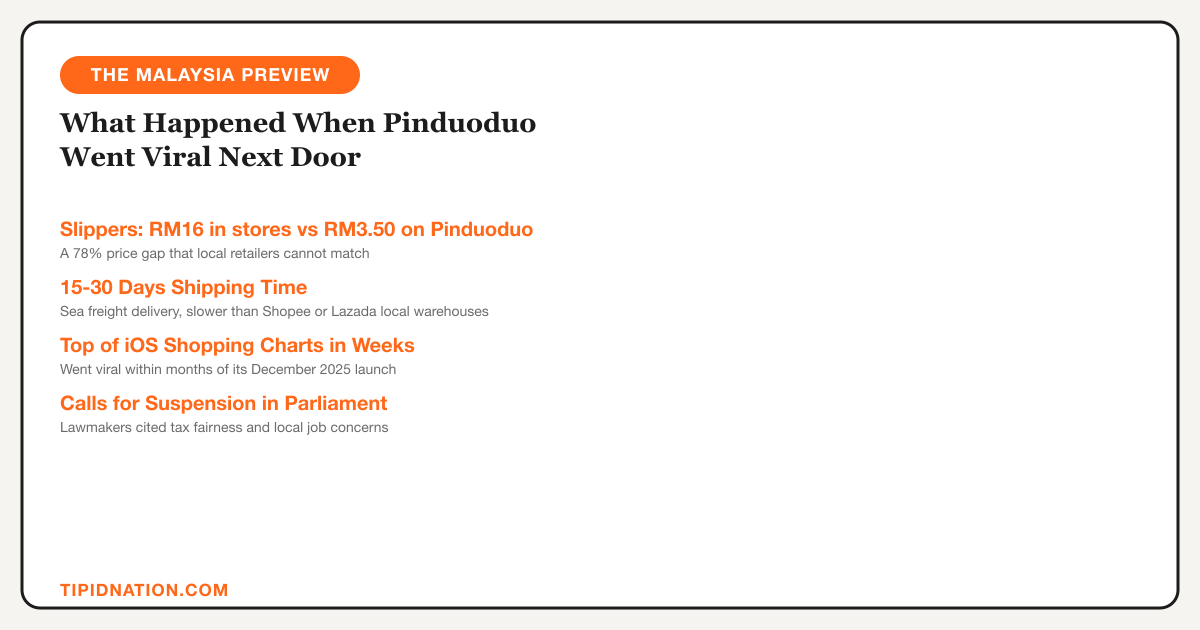
The backlash followed just as fast. ACCCIM president Datuk Ng Yih Pyng pushed back on the idea that price alone settles the fairness question, noting that "fair competition cannot be assessed based on taxation alone," pointing instead to product standards and seller verification as the real gap. MRCA president Datuk Liew Bin described member businesses feeling "a drag in sales and revenue," alongside concerns about counterfeit goods and consumer safety. It escalated to Parliament, where Gopeng MP Tan Kar Hing called for Pinduoduo's suspension pending a proper regulatory framework, while Prime Minister Anwar Ibrahim acknowledged the underlying tension around foreign platforms operating at scale, through Port Klang in that case, without creating local jobs to match.
Notably, most economists who weighed in favored tighter regulation over an outright ban, stronger tax enforcement and product-standard requirements rather than blocking the platform entirely. That's a more measured response than the loudest headlines suggested, and probably the more realistic template for how the Philippines would eventually respond too, if the same surge plays out here.
Why Divisoria and Facebook Resellers Should Pay Attention
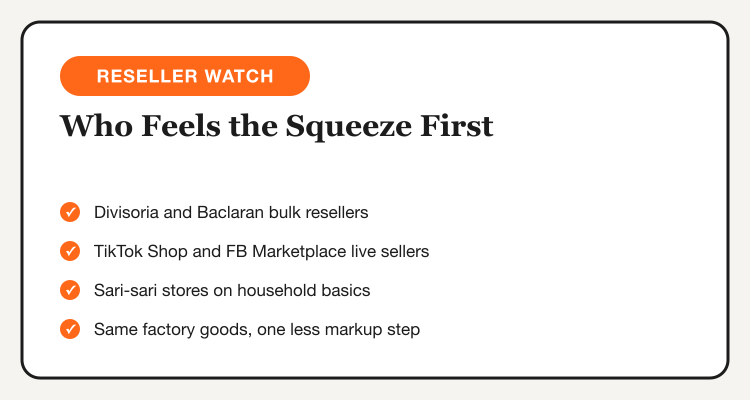
This is where the story stops being abstract for Filipino readers. A large slice of the Philippines' online resale economy, Divisoria and Baclaran stall owners, TikTok Shop and Facebook Marketplace live sellers, runs on the exact same playbook Pinduoduo is now offering directly to consumers: buy in bulk from Chinese wholesalers, mark up, and resell locally. If an ordinary shopper can order the identical item straight from the factory at a lower price, with free (if slow) shipping, the middleman step that a lot of small Filipino resellers occupy gets squeezed from both ends.
Sari-sari stores face a smaller but real version of the same pressure on household basics, the toilet paper and personal care items that made up some of Pinduoduo's most viral Malaysian price comparisons, though slow shipping and a preference for same-day availability still favor the corner store for anything needed today rather than in three to four weeks.
The Real Filipino User Experience So Far
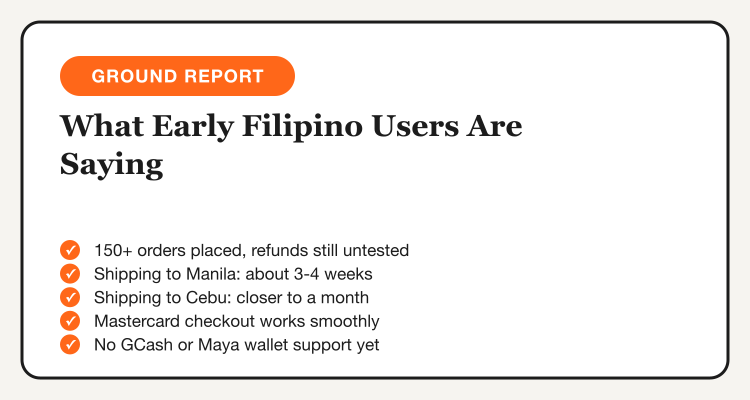
A separate Reddit thread in r/ShopeePH gives an early, honest ground-level comparison. The user's take: "the selection and prices in PinDuoDuo are much better compared to Shopee," with payment working smoothly through a linked Mastercard. But shipping is, in their words, "free shipping but slow as a snail," running close to a month to Cebu and a bit less to Manila. Most tellingly, after 150 orders placed, they hadn't received enough deliveries yet to speak to the refund and return process at all, a real gap in a market where Shopee and Lazada's fast local resolution on bad orders is a big part of why people trust them.
That's the honest state of things right now: real price and selection advantages, an unproven support and logistics track record, and a payment experience that works but skips the GCash and Maya wallet integration Filipino shoppers have come to expect by default from Shopee, Lazada, and TikTok Shop.
A Smarter Regional Answer Than a Price War
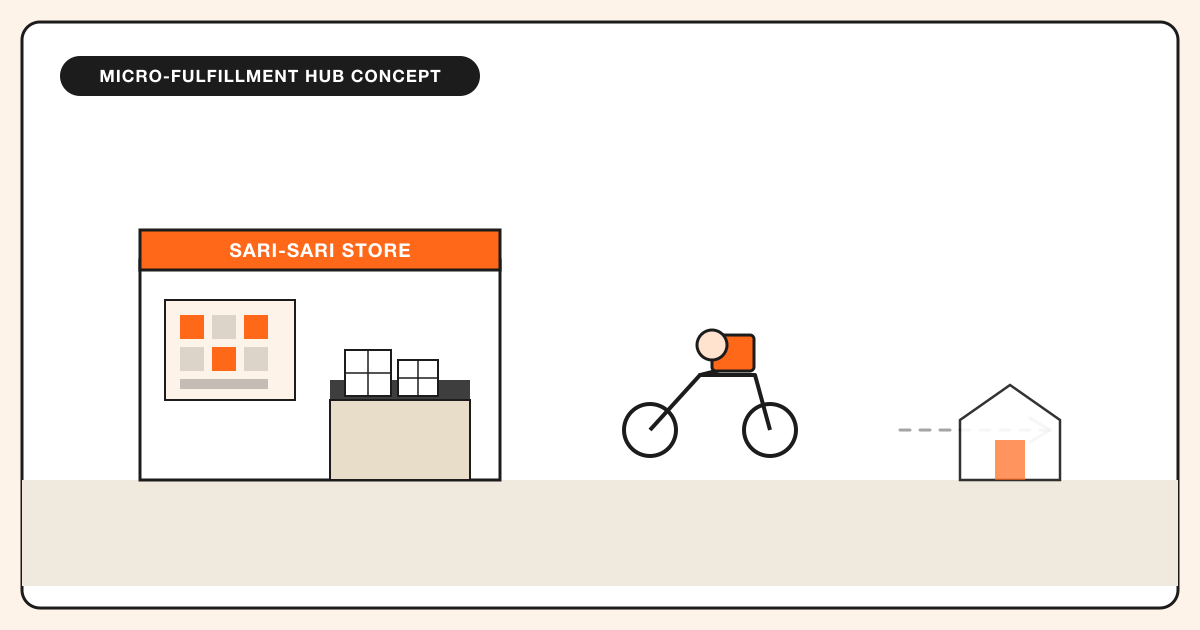
One argument worth bringing into the Philippine conversation comes from entrepreneur Simon Lim, writing in ThinkChina: competing with Pinduoduo purely on price is a losing game for Southeast Asian retailers, since a race to the bottom eventually leaves "merchants and platforms struggling to turn a profit" while consumers demand ever-cheaper goods. His proposal is a regional, AI-driven commerce network that turns the region's own dense retail footprint, sari-sari stores very much included, into fulfilment hubs: showrooms, micro-warehouses, and returns points that can offer same-day or next-day delivery, competing on speed and trust rather than matching rock-bottom pricing directly.
Lim's pitch specifically name-checks what a "Made in SEA" branded network could bring to global buyers, and the Philippines gets a direct mention: coconut and seafood products alongside Thailand's rice and spices, Vietnam's coffee, and Indonesia's furniture and handicrafts. Whether or not that exact platform gets built, the underlying point holds locally, Philippine sellers who lean into speed, local after-sales support, and genuinely distinctive local goods have a real answer to cross-border price competition that doesn't require matching a factory-direct price on identical mass-market items.
Where This Leaves Filipino Shoppers Right Now
Our honest read: Pinduoduo's prices and selection are likely real advantages for shoppers willing to wait three to four weeks and buy from an app still missing an official Play Store listing in the Philippines. That's not nothing, but it's also not yet a like-for-like replacement for Shopee or Lazada, whose local warehousing, GCash and Maya integration, and established refund processes solve real problems Pinduoduo hasn't proven it can solve here yet.
If Pinduoduo follows the same trajectory here that it did in Malaysia, expect a fast viral spike in downloads and orders, followed by a similar round of local seller pushback and eventual regulatory scrutiny, probably focused on the same two issues Malaysia raised: tax treatment of low-value imports and product safety verification. The Philippines' own de minimis threshold for duty-free imports has already been a live policy question with Temu and Shopee's cross-border sellers, Pinduoduo entering at scale would likely reopen that exact debate.
For now, our stance at TipidNation is straightforward: the value proposition is worth watching, but not worth rushing into on an unverified app with an unproven Philippine refund process. If you're comparing cross-border shopping apps already active and better-established here, our Temu vs SHEIN vs TikTok Shop comparison and AliExpress vs Temu breakdown cover the safer, currently-verified alternatives, and our Pinduoduo free shipping guide has more on how its shipping actually works today.
Frequently Asked Questions
Get more Pinduoduo Philippines codes, promos, and finds shared by fellow PDD shoppers in the Pinduoduo Philippines Facebook Group. For coupon code guides, redemption tips, and hacks for Pinduoduo worldwide, join the Pinduoduo Coupons Facebook Group.
Join Pinduoduo Philippines Group →