Why "Just Save More" Isn't the Real Problem
Almost every Filipino household knows they should have savings set aside. The gap isn't awareness, it's that most emergency funds get started the week after an emergency already happened, when it's too late to matter. A cracked motorcycle engine, an ER visit for a child's high fever, three weeks without a paycheck after a company retrenchment, these don't wait for a convenient payday.
The fix isn't a bigger salary. It's a specific number, a specific place to keep that money, and a specific starting amount you can hit this month, not "someday." That's what the rest of this guide walks through.
How Much Do You Actually Need?
The 3 to 6 month rule is the standard used by financial planners, but it only works if you apply it to essential expenses, not your total monthly spending. Essentials mean rent or amortization, food, electricity and water, transportation to work, phone and internet, and minimum payments on any existing debt. Leave out streaming subscriptions, dining out, and shopping, those get cut first in a real crunch anyway.
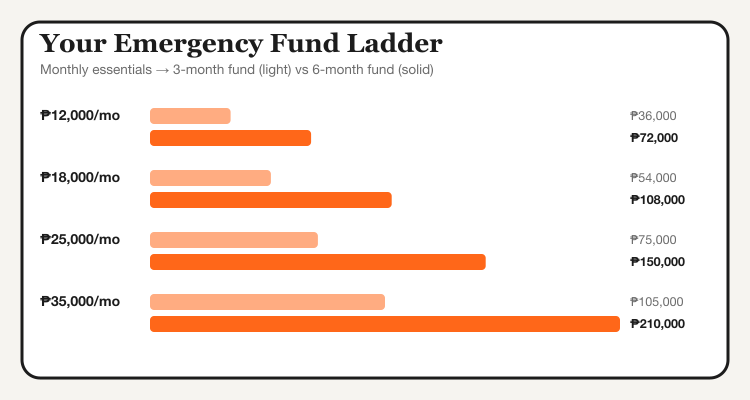
| Monthly Essentials | 3-Month Fund | 6-Month Fund |
|---|---|---|
| ₱12,000 | ₱36,000 | ₱72,000 |
| ₱18,000 | ₱54,000 | ₱108,000 |
| ₱25,000 | ₱75,000 | ₱150,000 |
| ₱35,000 | ₱105,000 | ₱210,000 |
Lean toward 6 months if your income is irregular (freelance, commission-based, gig work), if you're the sole earner in your household, or if you have young kids or aging parents depending on you. Lean toward the 3-month end if you have a stable job, a working spouse also earning, and no dependents yet.
Where to Actually Keep the Money
This is where a lot of people get it wrong. They either leave it sitting in a regular savings passbook earning close to nothing, or they lock it into a time deposit or mutual fund where it can't be touched without a penalty or a market dip working against them. Neither fits what an emergency fund is for.
What you want is a digital savings account that pays real interest and lets you withdraw the same day with zero penalty. GCash's GSave, powered by CIMB Bank Philippines, and Maya Savings both fit this. GoTyme Bank's Save Pockets work the same way and let you label a pocket specifically "Emergency Fund" so it's mentally and visually separate from your spending money. None of these lock your money up, which is the entire point, an emergency doesn't wait for a maturity date.
A useful trick: open the emergency fund account at a different bank or app than the one you use for daily spending. If your GCash wallet and your emergency fund are the same balance, it's too easy to "borrow" from it for a Shopee sale and never pay it back. A little friction between the two accounts protects the fund.
Building It From Absolute Zero
Open a GSave, Maya Savings, or GoTyme account today
This takes under 10 minutes if you already have GCash, Maya, or a valid ID for GoTyme. Don't wait until you have money to put in it, the account itself takes zero pesos to open.
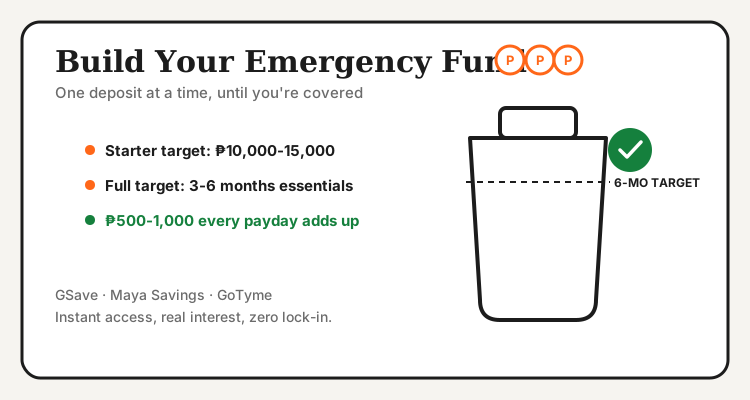
Set a starter target of ₱10,000 to ₱15,000
This is not your full 3 to 6 month goal. It's the amount that covers a common small crisis, a minor repair, a week of lost income, a clinic visit, without derailing your whole month.
Automate a fixed amount every payday
₱500 to ₱1,000 per payday adds up to ₱12,000 to ₱24,000 a year without ever feeling like a big decision. Set it up as a scheduled transfer right after your salary lands, before anything else gets spent.
Redirect windfalls before habits catch up to them
A 13th month pay, a tax refund, a bonus, or extra freelance income should go toward the fund first, at least half of it, before it gets absorbed into regular spending.
Scale up to the full 3 to 6 month target
Once the starter fund exists, keep contributing the same payday amount until you reach your real target from the table above. At that point, any extra savings can go toward a sinking fund or long-term investing instead.
Medical and Job-Loss Scenarios, Sized in Pesos
A typical ER visit for a fever or minor injury in a private hospital in Metro Manila, including consultation, basic labs, and medication, commonly runs ₱3,000 to ₱8,000 even without hospital admission. If admission is needed for a day or two, that jumps into the ₱20,000 to ₱50,000 range depending on the hospital and room type, even with PhilHealth covering part of the bill. This is exactly the kind of expense a ₱10,000 to ₱15,000 starter fund is built to absorb without touching a credit card or borrowing from a relative.
Costs shift outside Metro Manila, but not always downward. A private hospital ER visit in Cebu City or Davao City tends to land in a similar ₱3,000 to ₱7,000 range for the same basic workup, while smaller cities and municipalities often charge less for consultation and labs but have fewer specialists on-site, which sometimes means a transfer to a bigger regional hospital, and a second set of fees, for anything beyond a routine case. If you live in a province with limited hospital options, size your fund toward the higher end of the range and factor in a possible trip to the nearest city with full specialist coverage.
Job loss is the bigger reason to aim for the full 3 to 6 month target. Unemployment benefits through SSS only apply if you meet contribution requirements and typically pay out a fraction of your regular salary, and even then it takes weeks to process. If a ₱20,000-a-month earner loses their job, a 3-month fund of ₱54,000 buys real breathing room to job hunt properly instead of accepting the first offer out of desperation, even if it pays less or is a worse fit.
Money Gurus Worth Following
The emergency-fund-first mindset isn't a TipidNation invention, it's the starting point of nearly every serious personal finance framework, Filipino and international alike. A few names worth knowing if you want to go deeper than one blog post.
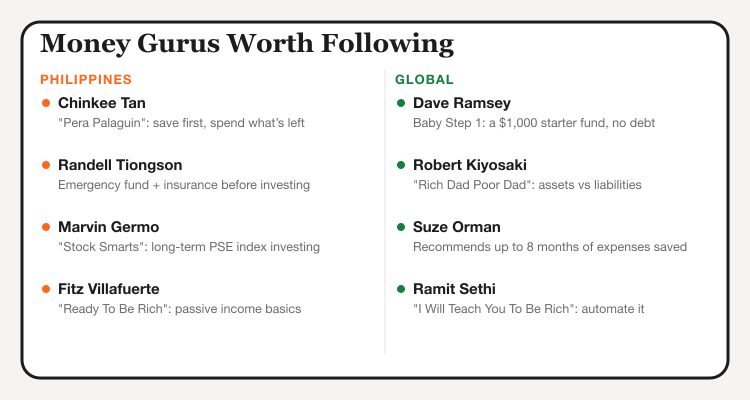
In the Philippines, Chinkee Tan, author of Pera Palaguin and a long-running financial literacy speaker, teaches a save-first philosophy: pay yourself first, then spend what's left, not the other way around. Randell Tiongson, a Registered Financial Planner and author of No Nonsense Personal Finance, structures financial priorities as a pyramid, emergency fund and insurance sit at the base, before any investing happens above it, which is exactly the order this guide follows. Marvin Germo, author of Stock Smarts, focuses on what comes after the fund is built: long-term, low-cost PSE index investing for ordinary Filipino earners. Fitz Villafuerte, who writes as "Ready To Be Rich," built one of the most-read Filipino personal finance blogs around practical passive income and investing basics for beginners.
Globally, Dave Ramsey's "Baby Steps" method, from his book The Total Money Makeover, puts a small starter emergency fund, $1,000 in his US framework, as literally Baby Step 1, before any extra debt payoff, the same starter-fund-first sequencing this guide recommends at a Philippine-appropriate ₱10,000 to ₱15,000. Suze Orman pushes further, often recommending 8 months of expenses for anyone with less job security, a useful data point if you're deciding between the 3-month and 6-month end of the range above. Robert Kiyosaki's Rich Dad Poor Dad reframes the emergency fund conversation entirely around assets versus liabilities, cash-flow-generating assets are what eventually make a large emergency fund less necessary. Ramit Sethi, author of I Will Teach You To Be Rich, is the closest match to this guide's automation-first approach: set up the scheduled transfer once, and stop relying on willpower for every payday.
Frequently Asked Questions
Current promo codes, cashback offers, and vouchers for GCash Philippines, updated regularly.
View GCash Deals →