PayPal vs Payoneer Philippines: Quick Answer
When freelancers search PayPal vs Payoneer Philippines, they are usually asking how to keep more of every invoice. The honest answer is that both charge fees, and the cheaper one depends on how you get paid. The table below sums up the main differences, using what the PayPal Philippines and Payoneer Philippines pages on TipidNation list.
| Category | PayPal | Payoneer |
|---|---|---|
| Best for | Direct clients, invoices, online shopping | Marketplace payouts (Upwork, Fiverr, Amazon) |
| Client reach | Widest acceptance, most overseas clients already have an account | Strongest when a platform offers it as a payout option |
| Reported fees | About 3% conversion charge and ₱50 for withdrawals under ₱7,000 (third-party reports) | Up to 2% for local bank withdrawals in a different currency (Payoneer blog), ₱50 for smaller ones (third-party reports) |
| Spending option | Pay foreign sites with buyer protection on eligible purchases | Prepaid Mastercard where available to your account |
| Withdrawal | To a linked Philippine bank in pesos, usually within a few banking days | To a Philippine bank in pesos, timing varies and first payouts can take longer |
Fee figures marked as third-party are reported by secondary sources and can change. Confirm them on each provider's own fee page before you quote a client.
When PayPal Makes Sense
PayPal wins on acceptance. Nearly every overseas client already has an account, so a PayPal invoice or PayPal.me link removes friction. It also doubles as a card-free checkout for foreign sites, with buyer protection on eligible purchases. The trade-off is cost: reports put the conversion charge at around 3%, which comes straight out of the peso amount you receive.
If you invoice small businesses, coaches or agencies directly, PayPal is often the path of least resistance. Ask clients to pay in the currency you hold where possible, since that can avoid an extra conversion step.
When Payoneer Makes Sense
Payoneer is where many Filipino freelancers collect payouts from marketplaces such as Upwork, Fiverr and Amazon, then send them to a local bank in pesos. It gives you receiving details in several currencies, and some accounts can order a prepaid Mastercard for spending the balance directly.
On fees, Payoneer's own blog says a local bank withdrawal in a different currency can cost up to 2%, and third-party comparisons list ₱50 for smaller withdrawals. Compared with a roughly 3% conversion charge, that can look cheaper, but the numbers depend on your currency, amount and account. Always check the screen that shows the final peso amount before you confirm.
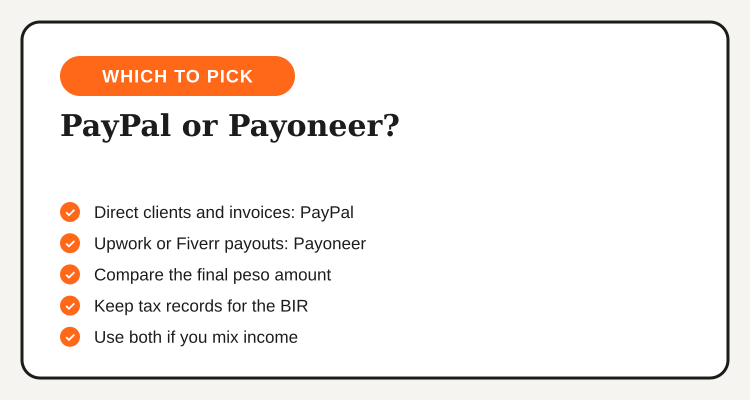
Which to Pick: Decision List
- Pick PayPal if most of your income comes from direct clients who prefer to pay by invoice or link.
- Pick Payoneer if most of your income arrives through Upwork, Fiverr or another supported marketplace.
- Use both if you mix direct clients and marketplace work, so each client pays through the route that costs you less.
- Look at Wise or Airwallex if you receive several currencies or want multi-currency business tools. See the Wise Philippines page and the Airwallex Philippines page, plus our Airwallex guide for OFWs and freelancers.
Moving Money to GCash or Coins.ph
Most freelancers do not spend straight from PayPal or Payoneer. They withdraw to a bank, then move money to a wallet for daily spending. Reports say GCash has charged 1% on PayPal cash-ins since March 7, 2026, so a bank withdrawal followed by an Instapay transfer can be the cheaper route for larger amounts. If you also buy crypto or pay bills in one app, the Coins.ph page lists wallet perks. Compare the final peso amount each route gives you.
A "Use Both" Setup That Keeps Fees Low
A simple setup is to give marketplace platforms your Payoneer details and send direct clients a PayPal invoice. Withdraw on a schedule instead of in small bits, since flat fees hurt more on small amounts. Then keep a record of every fee so you can add it to your next quote. For a full system on irregular income, read our freelancer budgeting guide, and if you are upskilling to win better clients, see the best Udemy courses for Filipino freelancers.
Tax and Safety Reminders
Income from freelance work can be taxable in the Philippines no matter which platform pays you. Keep records of every payment and consult the BIR or a licensed accountant about registration and filing. TipidNation does not provide tax advice and cannot promise any level of income. For safety, never share your OTP or password, only log in through the official app or site, and be careful of anyone who asks you to "release" a payment by sending money first.
Your 5-Step Freelancer Payout Plan
List your income sources
Separate direct clients from marketplace platforms.
Open the matching account
Use your legal name and a valid ID so verification and withdrawals do not get stuck.
Link your Philippine bank
Add and confirm your bank details before the first invoice.
Check the final peso amount
Read the fee screen and compare it with the invoice, not just the headline fee.
Record fees and set aside tax
Log each fee for future quotes and keep money aside for the BIR.
Frequently Asked Questions
TipidNation may earn commissions from qualifying purchases through affiliate partnerships. This helps support the platform at no additional cost to users.
Open the pages below to see current fees, offers and setup steps.