The USD Problem Every OFW and Freelancer Knows
Ask any Filipino working abroad or invoicing an overseas client the same question: how much of the original payment actually shows up in pesos? The answer is usually lower than expected, and it is rarely explained clearly. A $1,000 invoice or allotment does not convert at the rate you see on Google. It converts at whatever rate the receiving bank decides to apply, minus a handling fee, minus a correspondent bank charge if the wire passed through a third party along the way.
This is the quiet cost that OFWs on contract abroad and Filipino freelancers receiving USD payments both run into, just from different directions. A seafarer or contract worker paid in USD, AED, or SGD watches a chunk disappear in currency conversion before the peso amount even lands. A freelancer on Upwork, Fiverr, or a direct-client retainer sees the same thing happen to every invoice, month after month. Neither group is doing anything wrong. The system routing that money is simply built to profit from the exchange.
Why Bank Wires Cost More Than They Show You
A standard Philippine bank wire for a foreign currency payment usually stacks three separate costs. First, a flat handling or telegraphic transfer fee, often $15 to $25 regardless of the amount. Second, a correspondent bank fee if the payment passed through an intermediary bank abroad, which can shave off another $10 to $20 without ever appearing as a clear line item. Third, and often the biggest cost, the bank's own FX conversion margin, commonly 3 to 5 percent below the actual market rate.
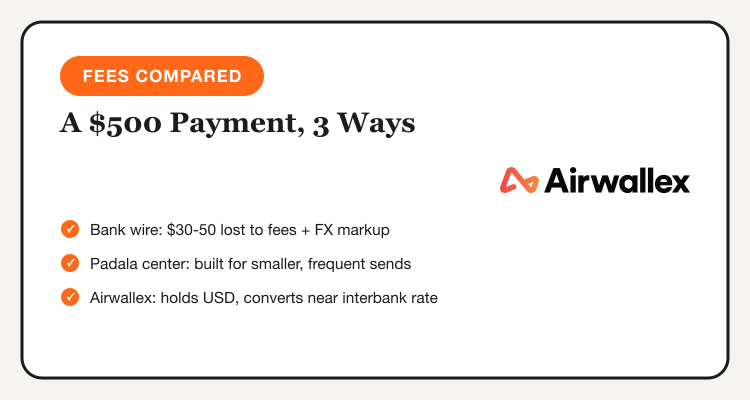
Add those together on a $500 payment and the loss lands somewhere between $30 and $50, roughly ₱1,700 to ₱2,800 at current rates. On a single transfer that might feel manageable. Received every month for a year, from a job contract or a steady freelance client, it adds up to tens of thousands of pesos that never had to disappear.
Worked out over a year, a freelancer receiving $800 a month through a standard bank wire loses roughly $24 to $40 per payment to spread and handling fees alone, before any fixed transfer charge is added on top. That is close to ₱15,000 to ₱25,000 annually, money that never shows up as a labeled deduction, just as a smaller peso amount landing than the invoice actually said. The frustrating part is how invisible it is. There is no single fee to point at and question, just a rate that always seems to work against you.
| Receiving Method | Typical Cost on a $500 Payment |
|---|---|
| 🟠 Standard bank wire | $15-25 flat fee + 3-5% FX markup, roughly $30-50 lost per transfer |
| 🟠 Padala or remittance center | Built for smaller, frequent transfers, capped amounts and receiver locations |
| 🟠 Multi-currency business account (Airwallex) | Holds the original currency, converts closer to the interbank rate when you choose to |
How Airwallex Changes the Math
Airwallex is a multi-currency business account that gives you receiving details in USD, EUR, GBP, and other currencies. When a client or employer sends a payment, it lands as USD and stays as USD, it is not auto-converted to pesos the moment it arrives. You choose when to convert, and the rate applied sits closer to the real interbank exchange rate than what a Philippine bank typically offers on an incoming wire.
That single design choice, holding the currency instead of forcing an immediate conversion, is what separates it from a standard bank account. Once you do convert, you transfer the peso balance out to a linked Philippine bank account or a GCash-supported bank, the same way you would move money from any account you already use.
Who This Actually Fits: OFWs Who Freelance, and Freelancers Full-Time
A word of clarity matters here. Airwallex is a business account, so it is not a replacement for a standard employer payroll allotment, which still routes through a manning agency or the local bank that agency uses. Where it fits is the growing number of OFWs who freelance on the side, whether that is a seafarer taking on remote graphic design work between contracts, a nurse abroad running a small consulting gig, or a returning OFW who has moved into full-time freelancing. It also fits Filipino freelancers billing international clients directly, regardless of whether they have ever worked overseas.
If your only foreign currency exposure is a monthly employer allotment with no invoicing involved, the savings here are limited, that money likely already moves through your manning agency's arrangement. But if you are receiving direct USD, EUR, or GBP payments from a client, marketplace, or your own side business, a multi-currency account is built exactly for that gap.
This describes a larger slice of the OFW community than it might first sound like. Long stretches of downtime between contracts, shifting work schedules abroad, and the appeal of an income stream that does not depend on a single employer have pushed a steady number of OFWs into freelance work on platforms like Upwork, Fiverr, and direct-client retainers, often billed in USD. Add in returning OFWs who transition into full-time freelancing or e-commerce after coming home, and the group actually receiving foreign currency invoices, separate from a payroll allotment, is bigger than it looks at first glance.
Setting Up an Airwallex Account
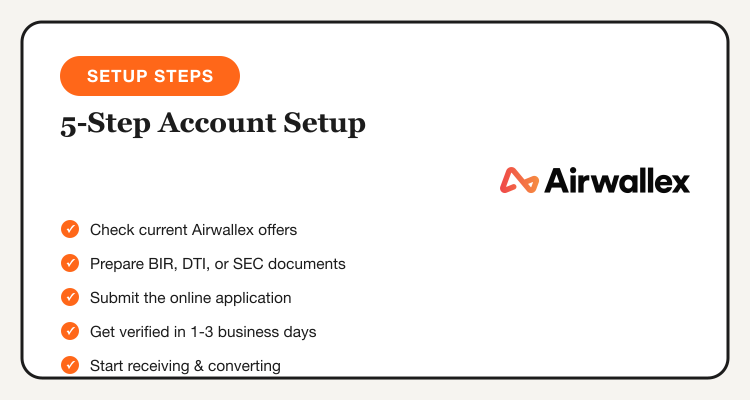
- Check current offers. Visit the Airwallex Philippines deals page to see if a fee-waiver or card-issuance promo is active before you apply.
- Prepare your documents. Freelancers registering as self-employed need a BIR Certificate of Registration; sole proprietors use DTI, corporations use SEC papers.
- Submit the online application. Complete the sign-up form and upload your business documents and a valid ID.
- Get verified. Approval typically takes 1 to 3 business days for accounts based in the Philippines.
- Start receiving and converting. Once verified, accept USD, EUR, or other foreign currency payments and convert only when you are ready.
Airwallex vs. Sticking With a Local Bank or GCash
None of this replaces the wallet already on your phone. GCash and Maya remain the better tools for paying bills, splitting expenses, and moving money locally once it has already converted to pesos, and they always will be, since that is what they were built for. Airwallex solves a narrower, earlier problem: what happens to a foreign currency payment before it ever reaches a peso account. The two are not competing for the same job. Most OFWs and freelancers who adopt Airwallex end up running it alongside GCash, using Airwallex as the landing point for USD or EUR income, then withdrawing converted pesos into GCash or a local bank for everyday spending.
It is also worth being honest about the tradeoff. A bank account requires no separate registration for an existing payroll or savings account, while Airwallex asks for business documents up front. That extra step is the price of avoiding the FX markup on every payment going forward, and for anyone receiving foreign currency regularly, it tends to pay for itself within the first one or two transfers.
Check current Airwallex account offers
Fee waivers and card-issuance promos rotate regularly. See what's active before you apply.
See Airwallex Philippines Deals →Bottom Line
The gap between what a client or employer sends and what lands in a Philippine bank account is not random, it is the predictable cost of routing foreign currency through a system built to profit from the conversion. For OFWs who freelance on the side and Filipino freelancers billing abroad, a multi-currency account like Airwallex removes the automatic markup by letting the payment sit in its original currency until you decide to convert it.
It will not replace GCash for everyday spending, and it is not meant to. But for the specific moment a USD, EUR, or GBP payment first arrives, it is the difference between losing a fixed cut to a bank every single time, and keeping more of what was actually earned.