Why ₱1,000 Is a Better Test Budget Than It Sounds
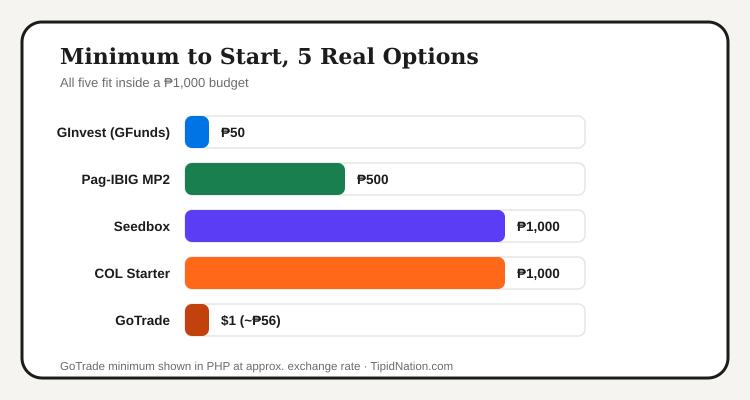
₱1,000 gets dismissed a lot in investing content, treated as too small to matter, something to save up from before "real" investing starts. That framing doesn't hold up against what's actually available on Philippine platforms today. ₱1,000 is enough to open a Seedbox account, a COL Starter PSE brokerage account, or a First Metro Sec account outright, and it's double the Pag-IBIG MP2 minimum and twenty times the GInvest (GFunds) minimum. The real question isn't whether ₱1,000 is enough, it's which of these five options actually makes sense for a first ₱1,000, since they differ sharply in fees, liquidity, and what you end up owning.
This guide treats ₱1,000 as a worked example rather than a hypothetical, walking through where that exact amount goes on each platform, what survives the entry fees, and how long it's realistically locked up. For the broader question of fund types and how they're taxed, our UITF vs mutual fund vs time deposit guide covers that ground in more depth. Here, the focus stays narrow: what happens to your first ₱1,000, specifically.

What ₱1,000 Actually Buys You Right Now
| Option | Real minimum | What you own | Entry fee on ₱1,000 | Liquidity |
|---|---|---|---|---|
| GInvest (GFunds) | ₱50 (local funds) | Mutual fund / UITF units | ₱0 (fund mgmt fee in NAVPU) | Sell anytime, days to settle |
| Pag-IBIG MP2 | ₱500 | Government savings, dividend-earning | ₱0 | 5-year lock-in, exceptions apply |
| Seedbox | ₱1,000 | Mutual fund / UITF units | Varies by fund, built into NAVPU | Sell anytime, days to settle |
| COL Starter / First Metro Sec | ₱1,000 | Individual PSE stock shares | 0.25% of trade or ₱20, whichever is higher | Sell during PSE trading hours |
| GoTrade | $1 (~₱56) | Fractional US stocks / ETFs | ~6%-9% combined (deposit + FX + trade) | Sell during US market hours |
Four of these five options charge nothing extra on the way in, the cost lives in an ongoing annual management fee baked into the fund's daily price, not a one-time cut off your deposit. GoTrade is the outlier precisely because of how it's funded, not because the platform itself is worse. A 3% e-wallet deposit fee plus an FX fee in the 0.5%-1.2% range plus a 0.15%-0.30% trading fee stack up to something in the 6%-9% range combined on a single small GCash or Maya deposit, our COL Financial vs First Metro Sec vs GoTrade comparison breaks the fee math down further for larger trade sizes, where the same percentages matter proportionally less.
The Fee Math That Actually Changes at Small Amounts
Percentage-based fees don't change at different investment sizes, but what they feel like does, especially for a beginner watching their first deposit. A 3% deposit fee is ₱30,000 on a ₱1,000,000 trade, an amount large investors shrug off, and ₱30 on a ₱1,000 deposit, an amount that can feel like a real dent when it's your very first one. GoTrade's fee structure isn't designed to punish small deposits specifically, but the math works out that way: a ₱1,000 one-time GoTrade deposit can lose ₱60 to ₱90 to combined fees before a single share is purchased, while the same ₱1,000 into GInvest, Pag-IBIG MP2, or a COL Starter stock purchase loses close to nothing on entry.
This doesn't make GoTrade a bad platform, our robo-advisor and investment apps comparison covers what it's genuinely good at: direct, fractional access to individual US companies and ETFs that none of the other four options offer. It does mean a single small ₱1,000 lump sum is the worst way to use it. GoTrade's fee drag matters far less once deposits get larger or more frequent, the 3% e-wallet fee and FX fee don't scale up with trade size, so a ₱10,000 deposit pays roughly the same percentage but the COL Starter-style flat ₱20 minimum commission starts looking comparatively larger instead.
A Simple Decision Framework: Horizon First, Then Platform
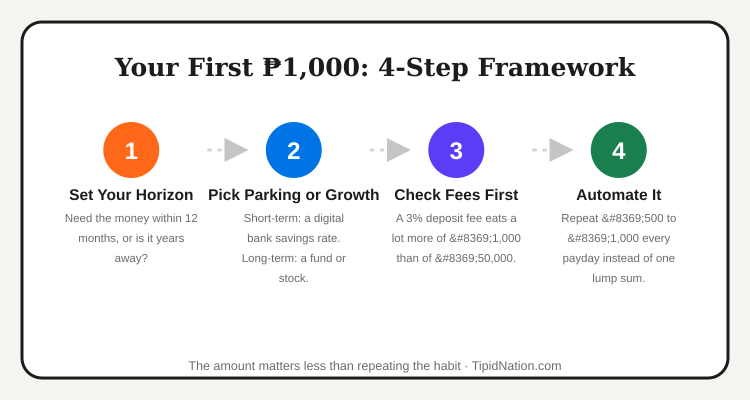
Before picking a platform, answer one question: will you need this exact ₱1,000 back within the next 12 months, or is it money you're setting aside for years? That single answer does most of the work of narrowing the five options down to one or two realistic candidates.
If the honest answer is "I might need it soon," none of these five is actually the right home for it, a high-yield digital bank savings account or a short-term time deposit is. GCash's GSave and Maya Savings both pay a base rate with no lock-in, and Maya's Time Deposit Plus currently pays up to 6% per annum on a 6-month term once you hit its target balance, our UITF vs mutual fund vs time deposit guide walks through those PDIC-insured options in more depth. If the honest answer is "years away, I won't touch it," that's when GInvest, MP2, Seedbox, COL Starter, or GoTrade genuinely apply, and the choice between them comes down to how much liquidity and control you want along the way.
GInvest and Seedbox: The Lowest-Friction Entry Points
GInvest, now labeled GFunds inside the GCash app, is the single easiest way to turn ₱1,000 into professionally managed fund units. Most local, peso-denominated ATRAM funds open at just ₱50, so a full ₱1,000 deposit is twenty times the real minimum, with GCash charging no transaction fee on either the buy or sell side. The only ongoing cost is each fund's own annual trust or management fee, typically in the 0.50%-1.75% range, already folded into the daily NAVPU rather than billed separately. Our full GInvest review covers which fund providers sit behind it and how selling actually works day to day.
Seedbox, a standalone fund marketplace run by ATRAM, opens with exactly ₱1,000, meaning this guide's test budget covers it precisely with nothing left to spare on a first deposit (subsequent top-ups drop to a ₱500 minimum). It isn't tied to an e-wallet the way GInvest is, which appeals to investors who'd rather keep fund investing in a dedicated app separate from everyday GCash or Maya spending, and it supports payroll deduction tie-ups with some employers for automating contributions straight from salary, a feature neither GInvest nor GoTrade currently matches in the same way.
Pag-IBIG MP2: The Highest Published Rate, With a Real Trade-Off
Pag-IBIG MP2 paid a 7.12% dividend rate for 2025, tax-exempt, announced at Pag-IBIG's Chairman's Report in early 2026, comfortably ahead of most bank time deposit promos and digital savings rates. The minimum is ₱500 per remittance, so ₱1,000 covers it twice over, or funds two separate contributions if you're testing the waters. You'll need an existing Pag-IBIG membership ID (MID) before opening an MP2 account, since MP2 is an add-on savings facility rather than a standalone product, our Pag-IBIG MP2 guide walks through enrollment and a worked growth example in full.
The catch is liquidity, not risk. MP2 locks your money for a full 5 years, and withdrawing early outside a specific list of exceptions (death, total permanent disability, retirement, permanent departure from the Philippines, OFW repatriation, critical illness, or documented job loss) costs you half the dividends you've earned, though your principal is always returned in full. For a first ₱1,000 you're confident you won't need before the next presidential election cycle ends, MP2's published rate is hard to beat among government-backed options. For a first ₱1,000 you're not sure about, that 5-year window is the deciding factor, not the rate.
COL Starter and First Metro Sec: Owning Individual PSE Shares
If what you actually want from your first ₱1,000 is direct ownership of a specific Philippine company, SM, Ayala, BDO, or any other PSE-listed name, GInvest and MP2 don't get you there, they pool your money into a fund. COL Starter and First Metro Sec both open with exactly ₱1,000 and put you on the Philippine Stock Exchange directly. Both charge the same standard PSE online commission, 0.25% of the gross trade value or ₱20, whichever is higher, plus regulatory pass-through charges (12% VAT on the commission, a small PSE transaction fee, and an SCCP clearing fee). On a ₱1,000 trade, the ₱20 flat minimum usually applies rather than the 0.25% rate, since 0.25% of ₱1,000 is only ₱2.50.
That ₱20 minimum commission is worth sitting with for a moment: on a ₱1,000 trade, it works out to roughly 2% round-trip just on the buy side alone, before the July 2025 stock transaction tax cut (from 0.6% to 0.1% on the sell side, under Republic Act 12214) is even factored in. Our COL Financial vs First Metro Sec vs GoTrade breakdown runs the full commission math at different trade sizes, the short version is that PSE brokers, like GoTrade, get proportionally cheaper as your deposit and trade size grow past a first ₱1,000.
What Not to Do With Your First ₱1,000
The biggest risk to a first-time investor's ₱1,000 usually isn't picking GInvest over Seedbox or COL Starter over First Metro Sec, every option above is a legitimate, regulated platform. The real risk is skipping all five and sending that ₱1,000 somewhere that promises a fixed "guaranteed" daily or weekly return with no clear fund, broker, or custodian behind it, a pattern common to unregistered investment scams targeting exactly this amount because it's small enough that victims don't investigate closely before sending it. If a platform can't point you to its specific SEC registration or PSE accreditation, that alone is reason enough to walk away, regardless of the return it's advertising.
Two smaller but still common mistakes: investing money you'll need within a few months (none of the five options above are built for that, a digital bank savings account is), and putting the entire ₱1,000 into a single volatile pick, whether that's one stock or one fund, while you're still learning how you personally react when the number on screen drops. A beginner's first ₱1,000 does more good teaching you the habit and the platform's mechanics than it does trying to maximize return on day one.
Frequently Asked Questions
See current GCash promos before topping up for GInvest, or compare Maya's savings and time deposit rates as a short-term parking spot while you decide.
View GCash Deals → View Maya Deals →