What GInvest (GFunds) Actually Is
GInvest is not a brokerage in the sense that GoTrade or a PSE-accredited broker is. It is a marketplace bolted onto the GCash app that connects your wallet to professionally managed mutual funds and unit investment trust funds (UITFs), sold and priced by SEC-registered fund providers. GCash's own help center has largely renamed the feature GFunds, though "GInvest" is still the name most Filipinos search for and the one GCash itself has used in past marketing. Functionally, they are the same product.
When you buy into a fund through GInvest, you are not buying individual shares of a company. You are buying units of a pooled fund, where a licensed fund manager decides how the pooled money gets invested across bonds, stocks, or other assets, and the daily Net Asset Value per Unit (NAVPU) tells you what each unit is currently worth. That price moves once a day, not in real time the way a stock quote does, which changes how you should think about timing a buy or sell order.
Minimum Investment and What You Can Actually Buy
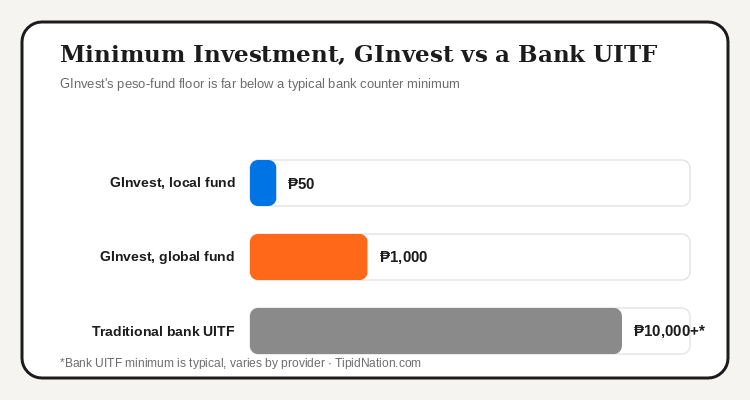
The number that draws most beginners in is the minimum: as low as ₱50 for most local, peso-denominated funds. Funds with foreign or global exposure, a technology-sector feeder fund or a global REIT fund, for example, typically raise the floor to ₱1,000. Either figure undercuts what a traditional bank branch usually asks for at the counter, where a ₱10,000-and-up opening deposit for a UITF is still common.
The fund menu spans a real range of risk levels rather than a single one-size-fits-all product. On the lower-risk end there are peso money market and fixed-income funds. In the middle there are equity funds tracking the PSEi's 30 component companies. On the higher-risk, higher-potential-reward end there are sector and global feeder funds, including options tied to global technology companies, global REITs, and multi-asset income strategies. The fund providers behind these products are ATRAM, one of the Philippines' larger independent asset managers, BPI Wealth, the wealth management arm of BPI, and Manulife Investment Management and Trust Corporation, with Ryse, Inc. supplying the wealth-tech plumbing that connects them to the GCash app.
Full GFunds Fund Lineup: Minimum Balance and Risk Rating
GFunds doesn't offer just one or two funds, there are 15 to choose from as of this writing, spanning conservative money market funds up through aggressive global equity and tech feeder funds. Each fund carries its own minimum maintaining balance, separate from the initial top-up minimum described above. Here's the full list, straight from GCash's own help center.
| Fund Name | Risk Rating | Min. Maintaining Balance |
|---|---|---|
| ATRAM Peso Money Market Fund | Conservative | ₱1 |
| ATRAM Total Return Peso Bond Fund | Moderate | ₱1 |
| ATRAM Philippine Sustainable Development and Growth Fund | Aggressive | ₱1 |
| ATRAM Philippine Equity Smart Index Fund | Aggressive | ₱1 |
| Philippine Stock Index Fund | Aggressive | ₱1 |
| ATRAM Global Infra Equity Fund | Moderately Aggressive | ₱500 |
| ATRAM Global Health Care Fund | Moderately Aggressive | ₱500 |
| ATRAM Global Equity Opportunity Fund | Aggressive | ₱500 |
| ATRAM Global Consumer Trends Feeder Fund | Aggressive | ₱500 |
| ATRAM Global Technology Feeder Fund | Aggressive | ₱500 |
| ALFM Global Multi-Asset Income Fund | Aggressive | ₱500 |
| Manulife Global Preferred Income Feeder Fund | Aggressive | ₱1,000 |
| Manulife Global REIT Feeder Fund | Aggressive | ₱1,000 |
| Manulife APAC REIT Fund of Funds | Aggressive | ₱1,000 |
| Manulife Asia Dynamic Bond Feeder Fund | Aggressive | ₱1,000 |
Top-up minimums follow a separate pattern depending on the fund provider and whether it's your first purchase of that fund or a repeat buy. For local, peso-denominated funds, ATRAM funds need ₱50 for both your initial and every following top-up, while BPI Wealth funds need ₱50 to start but drop to just ₱1 for succeeding top-ups. For global funds, ATRAM asks ₱1,000 upfront and ₱500 after, BPI Wealth asks ₱1,000 upfront and just ₱1 after, and Manulife holds steady at ₱1,000 for both.
One compliance detail worth flagging if it applies to you: several global feeder funds, including ATRAM's Philippine Sustainable Development and Growth Fund, its Global Consumer Trends, Technology, Infra Equity, Health Care, and Equity Opportunity feeder funds, plus the ALFM Global Multi-Asset Income Fund, the Philippine Stock Index Fund, and all four Manulife global feeder funds, are restricted from US persons and dual US citizens under standard fund provider compliance rules. That's a fund-provider restriction, not a GCash one, and it applies regardless of which app or broker you'd use to access these same underlying funds.
Fees: What GCash Charges vs What You Actually Pay
GCash itself charges no transaction fee to place a buy or sell order in GInvest, and there's no separate account maintenance charge either. That part is genuinely fee-free. What you do pay is an annual trust or management fee set by whichever fund provider manages the specific fund you hold, generally landing somewhere in the 0.50% to 1.75% per year range depending on the fund's strategy and provider. You'll never see that fee show up as a line-item deduction from your balance, because it's already factored into the fund's daily NAVPU before that price ever reaches your screen.
This matters for how you compare GInvest to alternatives. A fund with a 1.75% annual fee needs to outperform a lower-fee equivalent by that same margin just to break even on a like-for-like basis. It's worth actually opening the specific fund's fact sheet inside the app before buying, since the fee, past NAVPU movement, and risk classification are all disclosed there, rather than assuming every fund on the platform carries the same cost.
A Documented Example of How Returns Actually Play Out
One widely cited hands-on review of the platform illustrates something worth internalizing before you fund an account: different funds on the same platform, at the same time, can move in completely opposite directions. In that documented case, a ₱2,100 position in a PSEi-tracking equity index fund grew to roughly ₱2,226 in under two months, and a ₱7,500 position in a global technology feeder fund grew to roughly ₱7,771 in a little over a month. In the same review, a separate ₱4,000 position in a multi-asset income fund was down to roughly ₱3,857 over a longer holding period.
None of those figures are a forecast for what any fund will do for you today, markets move, and a fund's return over any specific stretch depends entirely on when you bought and what happened to markets during your holding period. The point is structural, not predictive: a GInvest equity or sector fund can post a meaningful short-term gain, and a GInvest fund, even a relatively conservative-sounding one, can post a loss over the same window. Comparing funds before buying, rather than assuming they behave similarly, is the more useful habit than chasing whichever fund happened to be up last quarter.
How to Open Your First GInvest Fund
Getting from a GCash app you already use to your first fund purchase is a short, linear process, most of it a one-time setup rather than something you repeat on every purchase.
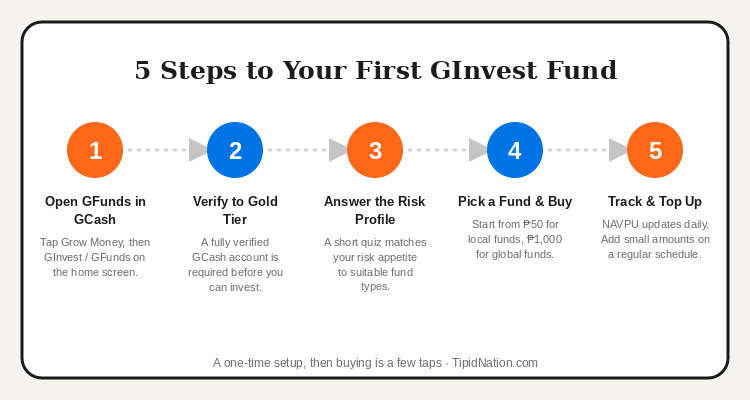
Two of those steps are worth flagging separately because they trip up first-timers. First, you need a fully verified GCash account before GFunds even unlocks, an unverified or partially verified wallet won't clear the gate. Second, the risk profile questionnaire is not a formality to click through, it genuinely shapes which fund categories the app will recommend to you, so answering it honestly about your risk tolerance and time horizon matters more than rushing to the buy button.
Who GInvest Fits and Who Should Look Elsewhere
GInvest is a strong fit for someone who wants diversified, professionally managed, peso-denominated exposure without downloading a separate app or opening a traditional brokerage account. The ₱50 entry point, the zero transaction fee, and the fact that it lives inside an app most Filipinos already open daily remove most of the friction that used to keep first-time investors out of funds entirely. Our broader comparison of GInvest, Seedbox, and GoTrade is a useful next stop if you're still deciding between app-based investing options rather than committed to GInvest specifically.
It's a weaker fit if your goal is direct ownership of individual US companies or index ETFs rather than a pooled peso fund, since GInvest doesn't offer that. For that specific goal, a platform like GoTrade, or a full-scale broker like IBKR, is built for the job in a way GInvest isn't. It's also a weaker fit for money you might need back within a few days, since sell orders settle on the next business day's NAVPU and proceeds can take a few more days to land in your wallet, GCash's own GSave feature is the better home for that kind of near-term buffer. And if what you actually want is to pick individual Philippine companies rather than let a fund manager decide, that's a job for a PSE-accredited stock broker, not a UITF marketplace.
None of these are mutually exclusive. A common, reasonable setup is starting small in a GInvest peso fund to build the habit of investing something every payday, while keeping GSave for money you might need on short notice and adding a US stock or PSE brokerage account later once your goals get more specific than "start investing something."
GInvest: The Short Version
What's genuinely good: a ₱50 minimum that removes the biggest barrier first-time investors face, zero transaction fees from GCash, a real spread of fund types from conservative to aggressive, and licensed providers (ATRAM, BPI Wealth, Manulife) actually managing the money rather than GCash itself.
What to go in expecting: a 0.50% to 1.75% annual fee embedded in every fund's NAVPU, next-business-day pricing rather than real-time trading, a multi-day path to get cash back into your wallet after selling, and real market risk on every fund, including the possibility of a loss over any given stretch. None of that makes GInvest a bad product, it's a normal description of how any regulated fund marketplace works. It just means the "worth it" answer depends on whether you're using it for what it's actually built for: small, regular, long-horizon contributions to a professionally managed fund, not a place to park money you'll need back next week.
Frequently Asked Questions
Sources: GCash GFunds product page and the GCash Help Center's GInvest/GFunds section. This article is general educational information, not personalized investment advice, always confirm current minimums, fund options, and fees directly in the GCash app before investing.
See current GCash promo codes and deals before you fund your GFunds account, or compare GInvest against Seedbox and GoTrade first.
View GCash Deals → Compare Investment Apps →