Why This Comparison Isn't as Simple as It Looks
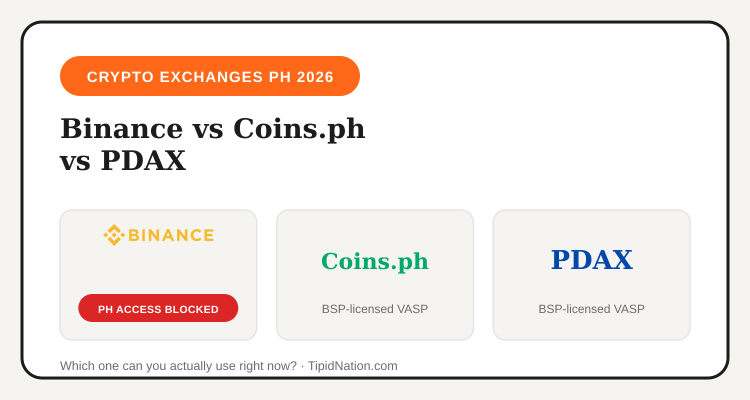
Most "best crypto exchange" roundups treat Binance, Coins.ph, and PDAX as three interchangeable options and compare them purely on fees. That framing skips the most important fact for a Filipino user in 2026: only two of the three are currently licensed and reachable through official channels. Binance has been under an NTC-ordered ISP block since March 2024, following a Securities and Exchange Commission cease-and-desist order issued in November 2023 for operating as an unregistered broker-dealer. The app was pulled from the Google Play Store and Apple App Store for Philippine users the same year, and a late-2025 enforcement sweep tightened the ISP-level block further across major telcos.
Coins.ph and PDAX are a different story entirely. Both are licensed Virtual Asset Service Providers under the Bangko Sentral ng Pilipinas (BSP), the country's central bank, and both let you fund an account with GCash, Maya, or a regular bank transfer. If your goal is simply to buy and sell crypto in pesos without wondering whether the app you're using is legally allowed to serve you, this guide leads with those two, and treats Binance's 2026 status as its own section worth understanding before you go looking for workarounds.
Binance in the Philippines: What "Available" Actually Means Right Now
Binance's regulatory trouble in the Philippines started with the SEC's November 2023 cease-and-desist order, which found the exchange had been offering securities-like products to the public without registration. The National Telecommunications Commission followed in March 2024, directing PLDT, Globe, Converge, and Smart to block access to binance.com at the network level, a directive that a late-2025 sweep reinforced across the same providers. Binance's app was separately removed from both the Google Play Store and Apple App Store for Philippine accounts in 2024, closing off the two most common installation paths for a new user.
In 2026, Binance pursued a narrower path back in through a local partner, BlockShoals Technologies, which received a Notice to Proceed with Testing from the SEC's Strategic Sandbox (StratBox) framework on April 14, 2026. That approval lets BlockShoals test aspects of a Binance-linked service under regulatory supervision, but it is not the same as Binance itself holding a BSP Virtual Asset Service Provider license. As of mid-2026 the BSP has publicly stated the arrangement still has a license gap, and there is no signed re-entry framework in place. Practically, that means the ordinary retail path, downloading the app locally and cashing in pesos, remains closed, whatever fee schedule Binance advertises globally (a flat 0.1% maker and taker on spot trades, lower with its BNB token) isn't something a typical Filipino user can act on through official channels today.
Coins.ph: The BSP-Licensed All-Rounder
Coins.ph, operated under the corporate name Betur Inc., has held a BSP VASP license since 2017, making it one of the longest-running licensed crypto platforms in the country. It's also the broadest of the three, functioning as an e-wallet, remittance service, and crypto exchange in one app. For most users, buying and selling happens through the Convert feature, which carries no separate trading fee, the cost lives in the buy/sell spread rather than a line-item commission.
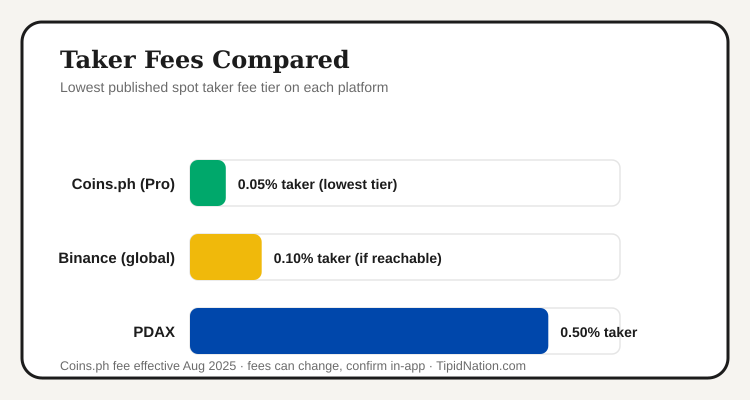
Traders who want tighter spreads can switch to Coins Pro, its dedicated spot trading interface, where fees drop as low as 0.03% for maker orders and 0.05% for taker orders at the lowest volume tier, a schedule that took effect in August 2025 and scales up with 30-day trading volume. Minimum buy amounts are set per token, generally ₱60 for major pairs like BTC/PHP and USDT/PHP, with a minimum deposit as low as ₱5. Funding runs through InstaPay from GCash, Maya, or most Philippine banks, and Coins.ph doesn't charge a deposit fee on incoming InstaPay transfers, though your sending bank or wallet might.
PDAX: The BSP-Licensed Peso-Native Exchange
PDAX (Philippine Digital Asset Exchange) has held its BSP VASP license since September 2018 and has built its product specifically around trading directly in pesos, rather than treating PHP as a secondary funding currency. Its minimum trade size sits at just ₱50, low enough that testing the platform costs almost nothing. Its published spot fee schedule runs higher than Coins.ph's lowest tier, with maker orders around 0.4% and taker orders around 0.5%, so PDAX tends to cost more per trade unless you're specifically drawn to its interface or product lineup.
That lineup is PDAX's real differentiator: beyond crypto, it also offers PDAX Gold starting at a ₱500 minimum, and access to Philippine government securities, treasury bills from ₱500 and retail treasury bonds from ₱5,000, inside the same app. For an investor who wants one account that spans crypto and government paper without juggling a separate brokerage relationship, that combination is hard to find elsewhere. Funding works through GCash, Maya, and bank transfer via InstaPay, similar to Coins.ph, though the specific fee on a cash-out to an e-wallet can vary by method.
Binance vs Coins.ph vs PDAX at a Glance
| Factor | Binance | Coins.ph | PDAX |
|---|---|---|---|
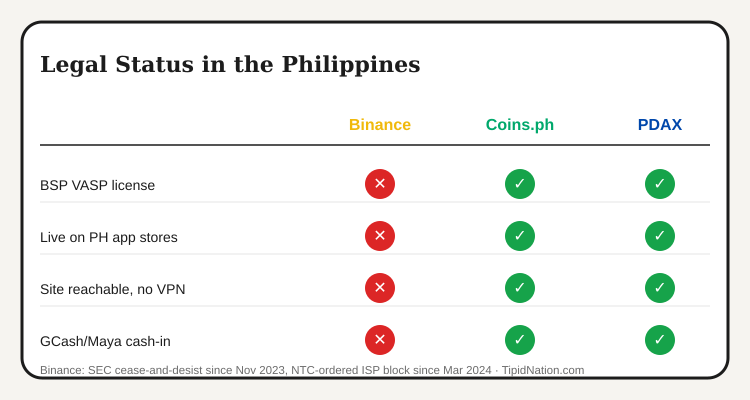
| BSP VASP license | No, license gap as of mid-2026 | Yes, since 2017 | Yes, since September 2018 |
| PH app store availability | Removed in 2024 | Available | Available |
| Site access, no VPN | Blocked by NTC order since March 2024 | Reachable | Reachable |
| Minimum trade | Not applicable through official PH channels | ~₱60-100 (min ₱5 deposit) | ₱50 |
| Lowest taker fee | 0.10% globally (if reachable) | 0.05% (Coins Pro, lowest tier) | ~0.50% |
| GCash/Maya funding | Not currently offered to PH retail | Yes, via InstaPay | Yes, via InstaPay |
| Extra products | N/A for PH users right now | E-wallet, remittance, bills pay | PDAX Gold, T-bills, retail bonds |
What ₱10,000 in Fees Actually Looks Like
Percentages are easy to skim past, so here's what they mean on an actual trade. Buying ₱10,000 worth of crypto as a market order (a taker trade, the type most beginners place) costs roughly ₱5 on Coins Pro's lowest tier (0.05%), close to ₱50 on PDAX (0.5%), and would cost about ₱10 on Binance's global 0.1% rate, if a Philippine retail account could actually reach it through official channels today. Using Coins.ph's fee-free Convert feature instead of Coins Pro removes even that ₱5, though the spread built into the conversion rate does some of the same work a fee would.
That gap matters more the more frequently you trade. An occasional buyer moving a few thousand pesos a month will barely notice the difference between 0.05% and 0.5%. Someone placing multiple trades a week will feel PDAX's higher rate add up meaningfully faster, which is a real reason to route routine crypto trading through Coins Pro and save PDAX for the government securities and gold products it offers that Coins.ph doesn't.
How to Actually Decide Between Them
Start with a question the fee tables can't answer for you: do you want the platform with the lowest possible cost per trade, or the one with the widest range of products under one BSP-licensed roof? If it's cost, Coins Pro's 0.03%/0.05% maker-taker schedule is difficult to beat among currently accessible options, and its parent app already handles e-wallet transfers and bill payments, useful if you'd rather not manage a separate app just for crypto. If it's breadth, PDAX's combination of crypto, PDAX Gold, and government securities in one account is a genuinely different value proposition than a pure crypto exchange, worth the higher trading fee for someone who wants that consolidation.
Binance doesn't currently enter that decision for a Philippine-based retail user, not because its global fee schedule is uncompetitive, it isn't, but because the SEC cease-and-desist and NTC block mean there's no compliant way to reach it through the app stores or website today. Chasing access around that block isn't something this guide recommends; if the BlockShoals sandbox arrangement eventually produces a full BSP license, that's a development worth revisiting, not a workaround worth pursuing in the meantime. For a broader look at where crypto fits against other beginner investing options in the Philippines, our Philippine stocks vs US stocks guide and best robo-advisor and investment apps roundup cover lower-volatility starting points if crypto's risk profile isn't where you want to begin.
Frequently Asked Questions
Check active GCash and Maya promos before you cash in to Coins.ph or PDAX.
View GCash Deals → View Maya Deals →