Three Products, Three Very Different Promises
Walk into any Philippine bank app and you'll see all three sitting next to each other: a UITF, a mutual fund, and a time deposit. They get lumped together as "ways to grow your savings," but they're structured, taxed, and risked differently. A time deposit is a bank deposit product, your principal is covered by PDIC insurance and your rate is fixed for the term. A UITF (Unit Investment Trust Fund) is a pooled fund managed by a bank's trust department, priced daily through a Net Asset Value per Unit (NAVPU) that moves with the bonds or stocks it holds. A mutual fund is similar in concept but structured as its own investment company registered with the Securities and Exchange Commission (SEC), typically sold through an asset manager like Sun Life, Philam, or ATRAM rather than a bank trust desk.
None of these is universally "the best," each is built for a different time horizon and risk tolerance. Our Pag-IBIG MP2 guide covers a fourth government-backed option worth comparing, and Philippine stocks vs US stocks looks at going beyond Philippine-based products entirely.
UITF vs Mutual Fund vs Time Deposit at a Glance
| Factor | UITF | Mutual Fund | Time Deposit |
|---|---|---|---|
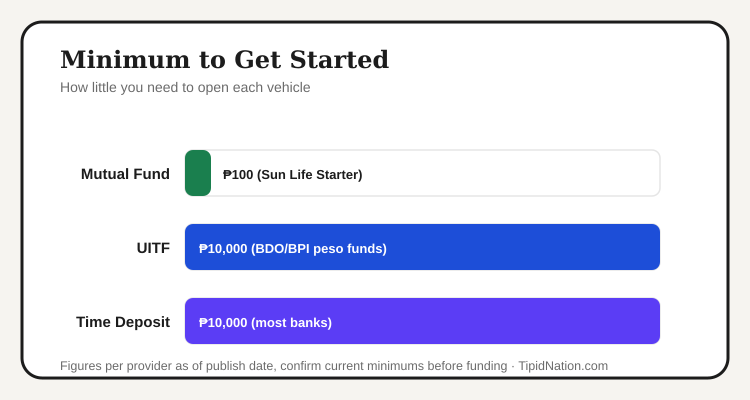
| Typical minimum | ₱10,000 (BDO, BPI) | ₱100 to ₱1,000 | ₱10,000 |
| Fees | Trust fee, ~0.25% to 2.00% p.a., in NAVPU | Sales load, 1% to 5%, plus mgmt fee | None |
| Return type | Variable, tied to NAVPU | Variable, tied to NAV/share | Fixed at placement |
| PDIC insured | No | No | Yes, to ₱1,000,000 |
| Liquidity | Redeem most business days | Redeem most business days | Locked; early exit forfeits interest |
| Managed by | Bank trust dept. (BDO Trust, BPI Wealth) | SEC-registered firm (Sun Life, ATRAM) | The bank itself |
| Best suited to | Medium-to-long goals | Small starting amounts | Short-term, zero risk tolerance |
What Each One Actually Is
A UITF pools money from many investors into a fund managed by a bank's trust department, invested in government securities, corporate bonds, or equities depending on the fund's strategy. At BDO, peso-denominated UITFs generally start at a ₱10,000 minimum, with trust fees from about 0.25% per annum on a money market-style Short Term Fund up to around 1.00% on an Equity Index Fund. BPI's lineup is similar, also starting at ₱10,000, with fees running higher for equity funds (1.75% on the Equity Value Fund) than short-duration ones (0.50% on the Short Term Fund). Neither bank charges a separate sales load, it's already in the daily NAVPU.
A mutual fund solves a similar problem through a different legal structure: its own SEC-registered company, where you buy shares rather than bank trust units. Sun Life Prosperity Funds prices its Peso Starter Fund at a ₱100 minimum, among the lowest entry points in either category. Its standard lineup (Balanced, Bond, Philippine Equity) generally starts at ₱1,000, while a foreign-invested fund like the World Income Fund requires ₱10,000. The tradeoff for that low entry is usually a front-end sales load, commonly 1% to 5%, deducted the moment you buy in, on top of an ongoing management fee.
A time deposit is the most familiar of the three: a fixed amount, term, and rate. It's a deposit, not a fund, which is why it carries PDIC deposit insurance up to ₱1,000,000 per depositor per bank. Traditional banks like Metrobank currently pay roughly 4.125% to 5% per annum depending on placement size and term. Digital banks are more aggressive: CIMB's MaxSave advertises up to 7.5% per annum on a 24-month term with a ₱10,000 minimum, and Maya's Time Deposit Plus pays up to 6.0% on a 6-month term.
Fees: Where Your Money Actually Goes
The fee structure is the part most beginners skip past, and it compounds over time more than expected. A UITF's trust fee is a single annual percentage already reflected in the NAVPU, nothing extra is deducted when you buy or sell. A mutual fund's front-end sales load works differently: on a 2% load, a ₱10,000 investment loses roughly ₱200 to the load before it's even invested, so the fund must grow past that gap first. Some companies waive or reduce the load for larger investments, worth asking about. A time deposit charges no fee at all, the advertised rate is what you earn, the simplest of the three to reason about, even though it typically offers lower long-term growth potential.
A ₱50,000 Worked Example
Numbers make the differences concrete. Say you have ₱50,000 to place for one year. This illustration uses currently published rates and typical fee ranges, not a guarantee, actual UITF and mutual fund returns depend on market performance and can come in lower or higher than any historical figure.
- Time deposit (traditional bank, 180-to-364-day term, around 4.5% p.a.): roughly ₱2,250 in interest, fixed and known in advance, no fees deducted.
- Time deposit (digital bank promotional rate, 6% to 7.5% p.a.): roughly ₱3,000 to ₱3,750 in interest, still fixed, still PDIC-insured.
- UITF (money market fund, trust fee already netted into NAVPU): return is not guaranteed, but money market UITFs have historically tracked close to time deposit-range yields, with no lock-in period.
- Mutual fund (balanced fund, 2% front-end sales load): ₱1,000 is deducted upfront, leaving ₱49,000 actually invested, so the fund must gain about 2% before you've broken even.
The pattern that matters is not which number is biggest in any given year, equity-linked funds can outperform or underperform a time deposit depending on market conditions during your holding period. It is that a time deposit's outcome is known the moment you place it, while a UITF or mutual fund's outcome is only known at redemption.
Risk and Safety: What Actually Protects Your Money
This is the distinction most beginners get wrong, because all three products are sold through the same bank app with similarly reassuring interfaces. A time deposit is a deposit liability of the bank, and PDIC deposit insurance covers up to ₱1,000,000 per depositor, per bank. If the bank fails, your principal up to that limit is protected.
A UITF or mutual fund is not a deposit, the units or shares you hold are not covered by PDIC insurance at all. Your money is invested in underlying securities, and if those lose value, your NAVPU or NAV per share falls with them, there is no insurance fund standing behind that loss. This is standard for any investment product, not a flaw specific to UITFs or mutual funds, but it's the core reason the two categories can't be compared on safety the way they can on potential return.
A Simple Way to Decide
Start with two questions: when do you need this money back, and how would you feel if the number went down before it went up. If the answer is "within a year or two" and you can't tolerate seeing the balance dip, a time deposit (or a conservative money market UITF, for more flexibility) is the better fit. If the money won't be touched for several years and you can sit through short-term swings, an equity-leaning UITF or mutual fund has historically had more room to grow, though that history is not a promise for your specific holding period.
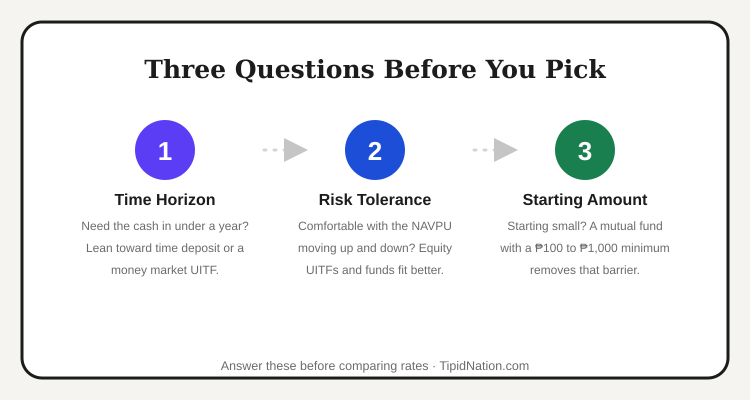
Starting capital matters too. A fund with a ₱100 minimum, like Sun Life's Peso Starter Fund, removes the barrier for someone building the habit of investing before they have ₱10,000 saved for a UITF or time deposit. None of these choices is permanent, splitting an amount across more than one is common as goals shift. Our GCash savings tips guide and robo-advisor apps comparison both cover app-based ways to start small, funded straight from an e-wallet.
This is general educational information to help you understand how each product works, not a personalized recommendation. Confirm current minimums, fees, and rates directly with the provider before funding an account.
Frequently Asked Questions
Check current GCash and Maya promos before funding a GInvest placement or a digital bank time deposit, or read the full Pag-IBIG MP2 guide for a government-backed alternative.
View GCash Deals → Pag-IBIG MP2 Guide →