What Pag-IBIG MP2 Actually Is
Modified Pag-IBIG II, or MP2, is a voluntary savings facility layered on top of the mandatory Pag-IBIG contributions every formally employed Filipino already makes. Where your regular Pag-IBIG savings sit until retirement or membership termination, MP2 runs on a fixed 5-year term and pays a separately declared, historically higher dividend rate. Both are administered by the Home Development Mutual Fund (HDMF), and both are government-backed rather than tied to stock market performance, which is the main reason MP2 gets compared to a time deposit more often than to an investment fund.
The distinction matters because MP2 is not a mutual fund or a UITF the way GCash's GInvest funds are. There is no NAVPU that moves daily and no market risk in the conventional sense, your principal is not going to post a paper loss the way a global equity fund can. What you are trading for that stability is liquidity, once your money is in MP2, it is largely locked there until the 5-year mark. Our comparison of GInvest, Seedbox, and GoTrade covers the market-linked side of app-based investing if that is what you are actually looking for instead.
The Current Dividend Rate, and How It Has Moved
Pag-IBIG declared a 7.12% dividend rate for MP2 savings for 2025, announced at the Fund's Chairman's Report on February 27, 2026, alongside a record P64.34 billion in total dividends paid out across all Pag-IBIG savings programs. Regular Pag-IBIG savings earned 6.62% over the same period. Both figures are tax-exempt, a status the Department of Finance has explicitly reaffirmed for Pag-IBIG savings, including MP2.
| Year | MP2 Dividend Rate | Regular Pag-IBIG Savings Rate |
|---|---|---|
| 2023 | 7.00% | 6.55% |
| 2024 | 7.10% | 6.55% |
| 2025 | 7.12% | 6.62% |
That upward drift is worth noting, but it is not a promise. The rate is declared once a year based on Pag-IBIG's actual investment income for that year, mostly from housing loans and treasury investments, so a weaker year for the Fund can pull it down just as a strong year has pulled it up recently. Whatever MP2 pays in any single year is not locked in for the full 5-year term you hold it, each year's contribution earns whatever rate gets declared for that year.
MP2 vs Everywhere Else You Could Park That Money
The number that actually matters is not MP2's rate in isolation, it's how that rate compares to the realistic alternatives, GSave, Maya Savings, and short-term bank time deposits, most Filipinos already use for savings they're not putting into stocks.
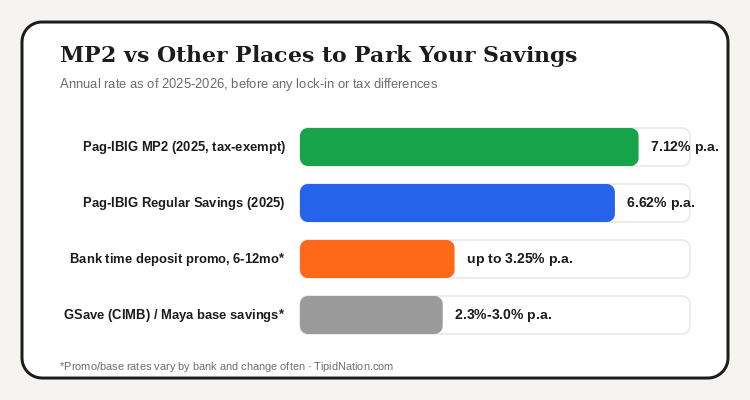
As of this writing, GCash's GSave feature (powered by CIMB Bank) pays a base rate of 2.30% per year, down from 2.60% after a June 2026 adjustment, with a 20% final withholding tax on the interest earned. Maya Savings pays a 3.00% base rate as of April 2026, with a boosted tier up to 15% available only on balances capped at ₱100,000 and only for users who meet specific in-app conditions. Traditional bank time deposit promos, such as Security Bank's April-to-June 2026 offer, ran 3.00% to 3.25% for 6- to 12-month terms, also taxed at the standard 20% final withholding rate. None of these comes close to MP2's 7.12%, tax-exempt, on a like-for-like annual basis, the trade-off is that all three let you get your money back in days or months instead of years.
A Worked Example: Contributing ₱1,000 a Month
Say you contribute a flat ₱1,000 every month for the full 5-year term, ₱60,000 in total principal. If the dividend rate held steady at the 2025 rate of 7.12% for all 5 years, which it will not exactly do since the rate is redeclared annually, a simplified estimate puts your ending balance somewhere in the ₱69,000 to ₱74,000 range, depending on exactly when within each year your contributions are treated as earning that year's dividend. That works out to roughly ₱9,000 to ₱14,000 in dividends on top of what you put in, entirely tax-exempt.
Treat that range as illustrative rather than a forecast. MP2's rate moved from 7.00% to 7.10% to 7.12% across the last three declared years, a real but modest upward trend, and there is no guarantee the next 5 years look the same. What the math does show clearly is the shape of the trade: a meaningfully better rate than a savings wallet or a short time deposit, paid out only if you can leave the money alone for the full term.
How to Enroll in Pag-IBIG MP2
Getting from an existing Pag-IBIG membership to your first MP2 contribution is a short process, most of it a one-time setup.
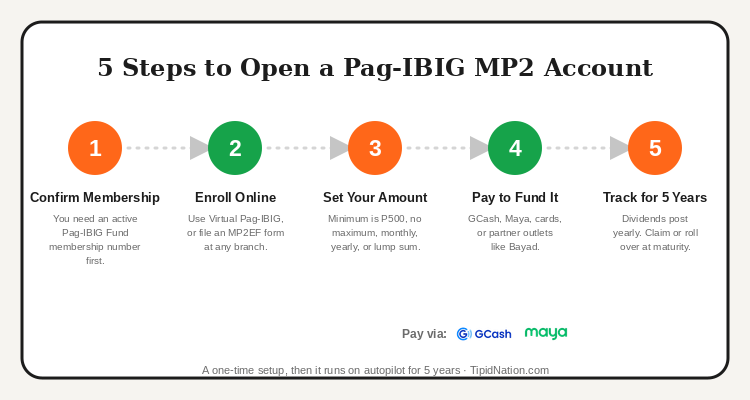
Virtual Pag-IBIG is the fastest route: log in with your existing Pag-IBIG online account, open the MP2 enrollment section, set your contribution amount and schedule, then fund it with GCash, Maya, or a debit or credit card. If you'd rather do this in person, any Pag-IBIG branch can process a Modified Pag-IBIG II Enrollment Form (MP2EF), with payment accepted through accredited partners including SM Business Centers, Bayad Center, and M. Lhuillier. Either path requires an active membership number first, MP2 is not open to someone who has never registered with Pag-IBIG at all.
Two rules apply once your contributions get larger. A single remittance over ₱100,000 requires you to submit proof of income or source of funds, standard anti-money-laundering compliance rather than anything MP2-specific. A single contribution over ₱500,000 has to be paid in cash or via manager's check in person at a branch, it cannot go through Virtual Pag-IBIG's online payment channels. Neither threshold affects a typical monthly contributor putting in ₱500 to a few thousand pesos at a time.
Early Withdrawal, Pre-Termination, and the New Rollover Option
MP2's 5-year lock is real, and there is no general early-withdrawal window the way some time deposits allow with a fee. Pag-IBIG does recognize a specific list of valid reasons for pre-termination without penalty: death of the member, total permanent disability, retirement, permanent departure from the Philippines, repatriation for OFW members, critical illness, or being classified as a distressed member due to job loss. Outside those circumstances, withdrawing before maturity costs you 50% of the dividends earned so far, your original principal contributions are always returned in full regardless of the reason for withdrawing.
A newer option worth knowing about: under Pag-IBIG Fund Circular No. 487, effective February 28, 2026, members can choose a one-time rollover at maturity that reinvests both the original principal and all earned dividends into a brand-new 5-year MP2 term, rather than claiming the payout in cash. To use it, you need to give consent either when you first enroll or within 6 months before your maturity date, it is not something you can decide on the day your account matures. Claims that are cashed out instead of rolled over typically process in 7 to 10 working days online or 15 to 20 working days at a branch, though processing tends to run slower from February through April, when Pag-IBIG is simultaneously handling annual dividend payouts for millions of members.
Who MP2 Fits, and Who Should Look Elsewhere First
MP2 makes the most sense for money you are confident you will not need inside 5 years, an emergency fund, a house down payment you might need next year, or anything with a shorter horizon belongs in something liquid like GSave, Maya Savings, or a similar accessible account instead, not MP2. It is also a solid complement to, rather than a replacement for, market-linked investing. If you're weighing MP2 against buying individual stocks or ETFs, our Philippine stocks vs US stocks guide covers that separate decision, and the two are not mutually exclusive, a common pattern among Filipino savers is building an MP2 position for the guaranteed-structure portion of their savings while investing separately for growth.
It is a weaker fit if you are still building your very first emergency fund, since locking money away for 5 years before you have any accessible buffer is generally the wrong order of operations. It also does not suit anyone who expects to need flexibility to adjust or withdraw contributions on short notice, that flexibility exists on the way in, you can pause or change your contribution amount, but not meaningfully on the way out before maturity.
Frequently Asked Questions
Sources: Pag-IBIG Fund's official MP2 page and Virtual Pag-IBIG, plus dividend-rate reporting from the Fund's February 2026 Chairman's Report. This article is general educational information, not personalized investment or financial advice, always confirm current rates, minimums, and requirements directly with Pag-IBIG Fund before contributing.
Pay your Pag-IBIG MP2 contributions through GCash, or compare it against GInvest and other app-based investing options first.
View GCash Deals → Compare GInvest Instead →