The Short Answer
There's no single winner, only a better fit for your room size and budget. Dyson tends to win on sensor precision and design versatility through its formaldehyde-detecting Purifier Cool and Hot+Cool lines, while Philips tends to win on affordability and compact sizing across its Series 800i, 2000i, and 3000i lineup. Picking between them comes down to how much room you're actually purifying and whether you need extra features like heating or fan mode bundled in.
Both brands sell across several product tiers, so comparing a specific Dyson model against a specific Philips model in the same price bracket gives a more useful answer than comparing the brand names alone.
Dyson and Philips Air Purifier Lineups at a Glance
Here's how each brand's core air purifier lines break down by use case.
| Use Case | Dyson | Philips |
|---|---|---|
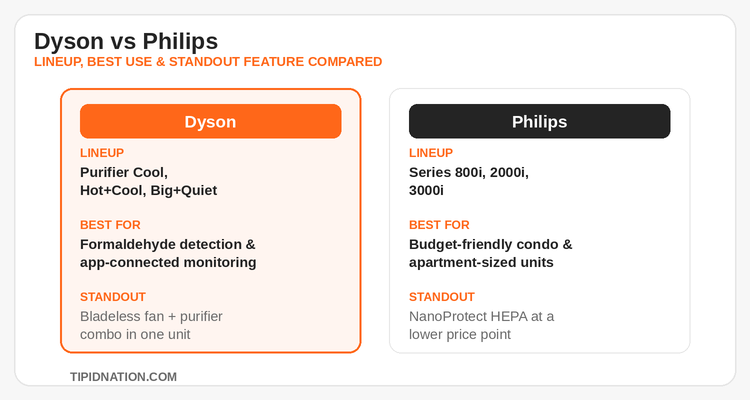
| Compact condo unit | Purifier Cool (smaller model) | Series 800i, 2000i |
| Purifier + fan combo | Purifier Cool | Not offered |
| Purifier + heater combo | Purifier Hot+Cool | Not offered |
| Larger living areas | Purifier Big+Quiet | Series 3000i |
| Local retail availability | Moderate | Wide |
Where Dyson Wins
Formaldehyde detection. Dyson's air quality sensors track formaldehyde specifically, alongside the usual PM2.5 and PM10 particle counts, and surface live readings through its app. That's a genuinely useful feature for anyone in a newly built or recently renovated unit, where off-gassing from fresh paint, adhesives, and furniture is a real concern in the first several months.
Bladeless fan and heater combo. The Purifier Cool and Purifier Hot+Cool lines double as a bladeless fan or heater on top of purifying air, a genuine space-saver for smaller units where one appliance doing two jobs matters more than owning the cheapest single-purpose purifier.
App-connected monitoring. Dyson's companion app shows real-time air quality graphs and lets you schedule auto mode based on detected pollutant levels, a feature set that appeals to buyers who want to actually see what their purifier is doing, not just trust that it's working.
View Dyson Philippines Deals →
Where Philips Wins
Lower upfront cost. Philips' Series 800i and 2000i units are priced well below Dyson's combo units, making them the more accessible entry point for shoppers who just want reliable particle filtration without paying for fan or heater functionality bundled in.
Compact sizing for condo living. Philips designs several of its units specifically for single-room condo and apartment coverage, with a smaller footprint that fits more easily on a side table or shelf compared to Dyson's taller tower-style units.
Wider local availability and cheaper filters. Philips has broader distribution across Philippine appliance retailers and marketplace stores, and replacement NanoProtect filters are generally easier to find and less expensive than Dyson's proprietary filter cartridges.
View Philips Philippines Deals →
Buying an Air Purifier in the Philippines
Both brands sell through official stores on Shopee and Lazada, and buying there is generally the safer route for guaranteed local warranty support versus gray-market units that authorized service centers may not honor. Marketplace listings also make it easy to compare current bundle promos, since air purifiers are frequently discounted alongside electric fans and dehumidifiers during major sale events. If you're timing a bigger appliance purchase, TipidNation's guide to the best time to buy appliances in the Philippines breaks down when prices actually drop across the year.
Filter replacement cost is worth factoring into your budget upfront rather than treating it as an afterthought, since it's a recurring expense that varies significantly between brands. It's also worth comparing coverage against your room's actual square footage rather than buying the biggest unit available, an oversized purifier in a small room wastes money without meaningfully improving air quality faster.
Your 5-Step Buying Guide
- Measure your room first. Match the purifier's rated coverage area to your actual room size rather than guessing, oversizing wastes budget and undersizing leaves pollutants uncleared.
- Decide if you need combo functionality. If you already own a fan or heater, a standalone Philips unit likely saves money over a Dyson combo model built to do both jobs.
- Check the sensor specs. If formaldehyde detection matters for your situation, such as a newly renovated unit, Dyson's dedicated sensor is the differentiator worth paying for.
- Factor in filter replacement cost. Compare the ongoing cost of replacement filters, not just the upfront unit price, before committing to either brand.
- Watch for an active sale window. Waiting for 11.11, 12.12, or a payday sale often narrows the price gap between both brands more than any single-day markdown.
Frequently Asked Questions
Compare current deals on both brands before you buy, updated regularly with the latest bundles and voucher-eligible listings.
View Dyson Deals → View Philips Deals →