What a Home Solar System Actually Costs
Solar pricing in the Philippines is usually quoted per kilowatt-peak (kWp) of panel capacity, roughly ₱45,000 to ₱75,000 per kWp installed as of 2026, and the total scales with how much of your daily electricity use you want the system to cover. A small system aimed at running lights, fans, and a refrigerator costs meaningfully less than one meant to also carry an air conditioning unit or a washing machine.
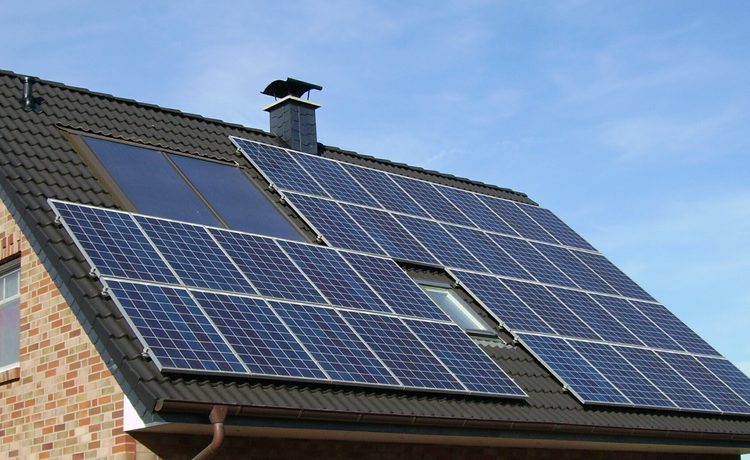
The table below groups typical Philippine residential setups by capacity, with real peso ranges pulled from multiple 2026 installer price guides. Treat these as starting reference points, not a quote, actual pricing depends on your installer, the panel and inverter brand tier, your roof condition, and whether battery storage is included.
| System size | Typical household fit | Installed cost (grid-tied) | Battery included |
|---|---|---|---|
| 1 to 2 kWp | Lights, fans, small appliances, a few outlets | ₱90,000 – ₱160,000 | Usually no |
| 3 to 5 kWp | Typical single-family home, one refrigerator, moderate daytime use | ₱150,000 – ₱280,000 | Optional add-on, +₱60K–150K |
| 6 to 10 kWp | Larger household, one to two air conditioning units, higher daytime load | ₱280,000 – ₱700,000 | Common with hybrid setups |
| 10 kWp and up | Large home or small business, most of the daytime load offset | ₱450,000 – ₱900,000+ | Usually yes for full backup |
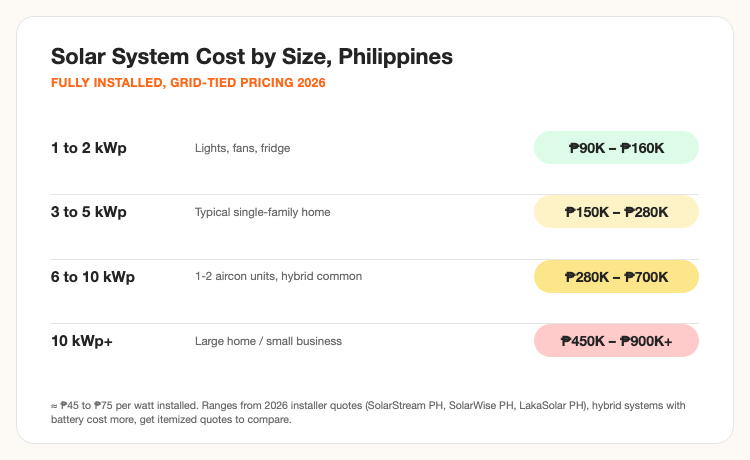
Notice that the cost per kWp does not move in a straight line with size. A larger system spreads fixed costs like permitting, mounting hardware, and labor over more panels, so the price per kilowatt-peak often improves as the system grows, which is one reason installers sometimes recommend sizing slightly bigger than your current bill suggests. Adding a lithium battery for backup power is a separate line item on top of these figures, typically ₱60,000 to ₱150,000 or more depending on the battery's storage capacity in kWh.
What Actually Drives the Price Up or Down
Two households asking for the same system size can get very different quotes, and the gap almost always traces back to a handful of variables rather than the panels themselves.
Battery storage is the single biggest swing factor. A grid-tied system without a battery is the cheapest configuration because it only needs panels, an inverter, and mounting. Adding lithium battery storage for backup power during outages adds roughly ₱60,000 to ₱150,000 or more on top of the base system cost, since batteries are priced separately from the solar array and sized by how many hours of backup you want, a 5kWh battery costs meaningfully less than a 10-15kWh bank sized for whole-house backup.
Panel and inverter brand tier matters next. Established international brands with longer warranties generally cost more than newer or budget brands, though the gap has narrowed as more manufacturers entered the market. Roof condition and mounting complexity also affect labor cost. A simple, unshaded, structurally sound roof is cheaper to work with than one that needs reinforcement, has multiple angles, or requires extensive shade-tree trimming first.
Installation labor and permitting fees are the least visible line item but still add up, particularly the utility coordination needed for net metering approval. Ask every installer to itemize labor and permitting separately from equipment cost so you can compare quotes fairly instead of comparing one bundled number against another.
Grid-Tied vs Off-Grid vs Hybrid Systems
Most Philippine homeowners choose between three system types, and picking the wrong one for your situation is the most common way people either overspend or end up disappointed with what the system actually does during an outage.
| System type | Upfront cost | Works during a grid outage | Net metering eligible |
|---|---|---|---|
| Grid-tied | Lowest | No, shuts off for safety | Yes, standard fit |
| Hybrid | Mid to high | Yes, for battery-backed circuits | Yes, most common choice |
| Off-grid | Highest per usable kWh | Yes, fully independent | Not applicable, no grid connection |
Grid-tied is the right call for most Metro Manila and urban households whose main goal is lowering the electric bill and who can tolerate the grid outages they already experience. Hybrid fits homes in areas with frequent brownouts that still want to stay connected to the grid for net metering credit. Off-grid is mainly for remote properties with no grid connection at all, and it is priced very differently because every watt of power the household uses has to come from stored battery capacity rather than the grid as a fallback.
Net Metering and How Payback Actually Works
Net metering is the mechanism that makes a grid-tied system pay for itself faster. When your panels generate more power than the household is using at that moment, typically around midday, the excess flows back into the grid and your distribution utility credits it against your bill. The program is regulated at the national level by the Energy Regulatory Commission, and it is administered locally by your distribution utility, such as Meralco in Metro Manila or your area's electric cooperative elsewhere.
Applying for net metering is a separate step from buying the panels. Your installer typically submits the application on your behalf, the utility reviews the design, and a bidirectional meter gets installed once approved. Processing time and documentation requirements vary by utility, so ask your installer for a realistic timeline rather than assuming it happens the same week the panels go up.
Payback period, meaning how many years it takes the system's bill savings to equal what you paid for it, depends on your system cost, your household's actual electricity consumption pattern, and how much of your usage happens during daylight hours when the panels are producing. A household that runs most of its major appliances in the evening will see a longer payback than one with heavy daytime use, even with an identical system. Ask any installer for a payback estimate built from your last twelve months of actual electric bills, not a generic industry figure.
Starting Small Before Committing to a Full System
A full rooftop installation is a significant purchase, and it is reasonable to start smaller while you decide whether it is worth it for your household. Portable solar panels, solar-powered garden lights, and solar power banks are a low-risk way to get a feel for solar charging before signing a contract for a whole-home system, and they are genuinely useful on their own for camping, outages, or areas with unreliable power.
These smaller accessories are widely available through Shopee Philippines deals and promo codes, where sellers list foldable panel kits and solar chargers across a wide price range, and through Lazada Philippines vouchers and discount codes, which carries similar accessories from both local and international sellers. A basic solar power bank typically runs ₱800 to ₱2,000, with higher-capacity or fast-charging models going up to around ₱3,500. Compare wattage output and battery capacity rather than panel size alone, since a physically larger panel does not always mean faster charging. Checking current vouchers on either platform before checkout is a simple way to shave a bit more off an already inexpensive purchase.
None of this replaces getting proper quotes for a rooftop system if that is the goal. It is simply a lower-cost way to understand how solar charging performs in your specific location before committing to a bigger installation.
Questions to Ask Before You Get a Quote
- Ask for an itemized breakdown. Panels, inverter, mounting, battery if included, labor, and permitting should each appear as separate line items, not one bundled total.
- Ask whether net metering paperwork is included. Some installers handle the utility application as part of the project; others leave it to you.
- Ask for a payback estimate based on your actual bills. A generic industry estimate is far less useful than one built from your last year of consumption.
- Ask about warranty length on panels and inverter separately. These two components often carry different warranty terms from different manufacturers.
- Get at least three quotes for the same system size. Pricing and included scope vary enough between installers that a single quote rarely tells you whether you are getting a fair deal.
The Short Version
Solar system cost in the Philippines is driven mainly by size, whether battery storage is included, and the brand tier of the equipment, not by a single fixed price per panel. Grid-tied systems without a battery are the cheapest way to lower a bill through net metering, while hybrid systems cost more but keep the lights on during an outage. Get an itemized quote from more than one installer, confirm who handles the net metering application, and consider a small solar accessory first if you are still deciding whether the bigger investment is worth it.
Peso ranges sourced from 2026 Philippine installer price guides: SolarStream PH, SolarWise PH, and LakaSolar PH. Actual quotes vary by installer, brand tier, roof condition, and battery capacity, always confirm current pricing directly with your installer. Rooftop solar photo: Wikimedia Commons, public domain.