
The Short Answer
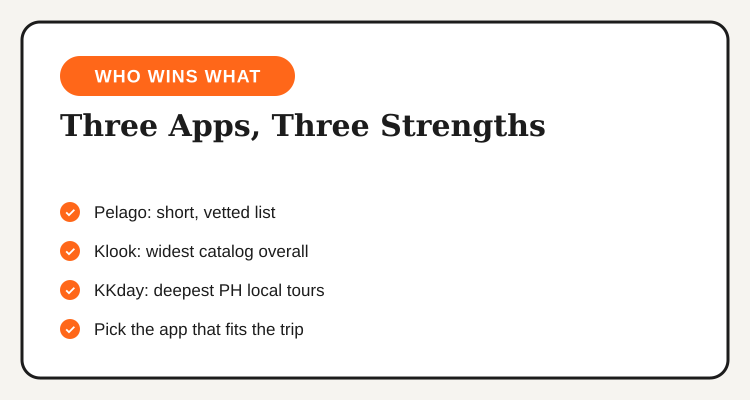
Pelago wins on curation. Singapore Airlines built it as a shorter, quality-screened list of tours and activities, useful when you would rather pick from ten reviewed options than scroll through a hundred. Klook wins on volume, it lists more vendors, more destinations, and more add-ons (eSIM, transfers, theme park bundles) than either competitor. KKday wins on local Philippine depth, its day-tour pickup coverage for Boracay, Cebu, and Palawan often beats Klook on price and convenience.
None of the three is the obvious default for every booking. The better question is which tradeoff fits the trip: do you want fewer, pre-screened choices, the widest possible catalog, or the deepest local Philippine supply.
At a Glance, Pelago vs Klook vs KKday
A side-by-side look at how the three compare on what actually matters when booking a trip.
| Factor | Pelago | Klook | KKday |
|---|---|---|---|
| Catalog approach | Curated, vendor-screened | Open, widest volume | Open, regional focus |
| Philippine local tours | Thin coverage | Strong | Strongest, best pickup coverage |
| International attractions (SG, Bali, Japan) | Strong, SIA route focus | Strongest overall | Comparable, occasional exclusives |
| eSIM & connectivity | Not offered | Widest selection | Comparable |
| Price competition per listing | Lower, fewer vendors per slot | High | High, especially for PH tours |
| Decision time per booking | Fast, short list | Slower, more to compare | Moderate |
| Loyalty currency | Pelago credits, some KrisFlyer tie-ins | KlookCredits | KKday Points |
Where Pelago Wins
A shorter, pre-screened list beats scrolling for some travelers. Pelago, built by Singapore Airlines, reviews which tour operators get listed instead of opening the platform to anyone who signs up. For a traveler planning a trip in a spare hour, that matters more than having two hundred near-identical options to sort through. The tradeoff is a smaller catalog, especially for destinations outside Singapore Airlines' core routes.
Fewer low-quality operators slipping through. Because Pelago's listings go through a review step before publishing, the worst-case outcome, a tour operator that cancels last-minute or delivers far below the listing, shows up less often than on fully open marketplaces. That is not a guarantee, but it is a real difference in how the catalog is built.
Clean bundling for Singapore, Bali, and nearby destinations. Pelago's strongest coverage sits along routes Singapore Airlines flies often, so travelers connecting through Singapore or booking a Bali or Tokyo leg tend to find useful bundles here that Klook and KKday don't package the same way.
Card-linked discounts stack cleanly. Pelago runs periodic Visa and Mastercard promotions that apply at checkout without extra steps, on top of whatever seasonal sale or flash deal is already live.
Where Klook Wins
Nothing beats Klook on raw catalog size. More destinations, more vendors per attraction, and more add-on categories (eSIM, pocket WiFi, airport transfers, theme park bundles) than either Pelago or KKday. For a trip touching three or four countries, Klook is usually the one app that covers every leg.
Theme parks and major attractions. Klook's pricing on Hong Kong Disneyland, Universal Studios Japan, and similar big-ticket attractions is consistently competitive, and its bundled deals (ticket plus express pass plus meal voucher) are often exclusive to the platform.
The widest eSIM and connectivity selection. Klook's travel deals page covers more countries and data tiers than either competitor, with faster activation for international trips.
More price competition on identical tours. Because Klook opens listings to far more vendors, the same attraction often has five or six competing operators, which pushes prices down in a way a curated catalog structurally cannot. The cost is more time spent comparing before booking.
Where KKday Wins
The deepest Philippine local tour catalog of the three. For Boracay island hopping, Cebu whale shark tours, Palawan El Nido trips, and Bohol countryside day tours, KKday frequently beats both Klook and Pelago on pickup-point coverage and price. Pelago barely competes here at all, its catalog skews toward international destinations near Singapore Airlines routes.
Last-minute inventory releases. KKday's day-before and same-day availability, often released as tours fail to fill, can beat Klook's pricing for spontaneous travelers who decide on a tour the night before.
Specific exclusive supply. Certain local operators list only on KKday, not Klook or Pelago. Checking all three before booking a niche experience, a specific dive shop, a particular countryside guide, takes a few extra minutes and sometimes surfaces an option the bigger platforms simply don't carry.
For current KKday promo activity, the KKday Philippines deals page tracks active codes updated regularly.
Curated vs Volume: Which Actually Matters for Your Trip
The honest answer is that curated and volume solve different problems, and most Filipino travelers end up using more than one app per trip. A curated list saves decision time: Pelago is the right call when you want to book an activity in ten minutes without reading forty reviews first. A volume catalog saves money through competition: Klook and KKday's open listings mean more vendors fighting for the same booking, which tends to push prices down, at the cost of needing to actually compare them.
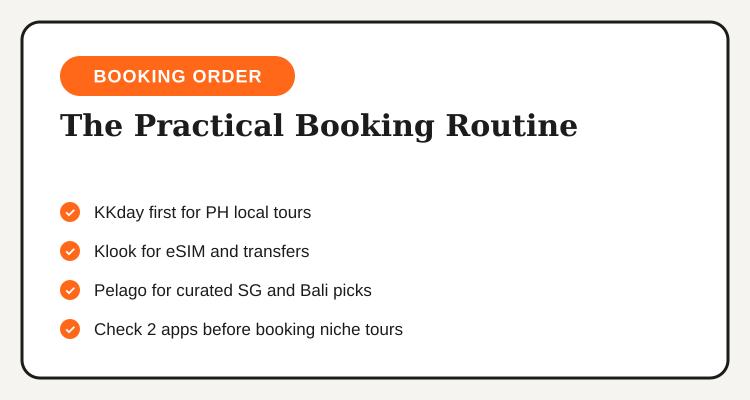
For trips centered on the Philippines, the practical order is usually KKday first for local day tours, Klook for everything else (eSIM, transfers, attractions outside PH), and Pelago when the itinerary touches Singapore, Bali, or another Singapore Airlines route and a shorter, vetted list is worth more than comparing a dozen near-identical options.
A Worked Example: Manila, Singapore, Then Bali
Picture a two-week trip: fly out of Manila, spend three days in Singapore, then hop to Bali for a week. Booking this with only one app wastes money or time. Opening Klook for the Singapore leg means scrolling past dozens of near-identical city tour listings to find the two or three worth booking. Opening Pelago instead cuts that list down immediately, since its Singapore catalog is the platform's strongest and every operator on it has already passed a screening step.
Bali works the same way. Pelago's curated picks (a sunrise volcano trek, a rice terrace tour, a few beach club day passes) cover the highlights without forty competing listings to sort through. For anything more specific, a particular surf lesson, a niche cooking class, Klook's broader catalog usually has it, just with more comparing required to find the right vendor.
Now swap the destination to a domestic leg, say a side trip to Coron before flying home. Pelago's coverage thins out fast here, it was never built around Philippine local tours. KKday becomes the better opening tab, with Klook as the fallback for anything KKday doesn't list. The pattern holds across most itineraries: Pelago for a fast, vetted shortlist abroad, KKday first for anything inside the Philippines, Klook as the wide net that catches what the other two miss.
Voucher and Points Rules to Know Before Booking
All three apps allow one promo code per booking plus their own loyalty currency, but the currencies don't cross over. Pelago credits only redeem on Pelago, KlookCredits only on Klook, KKday Points only on KKday, and none of the three accept a competitor's promo code. Travelers who book often tend to settle on one platform per category (KKday for PH tours, Klook for everything international) so points and credits actually build toward something redeemable instead of sitting scattered across three separate wallets.
GCash and Maya are accepted at checkout on all three, sometimes unlocking a separate e-wallet-linked discount on top of whatever platform voucher is already applied, which is worth checking before paying.
Active Pelago, Klook & KKday PH Codes
These collection pages track current promo activity for each platform, refreshed on a regular schedule.
| Platform | Best For | Updated | |
|---|---|---|---|
| Pelago | Curated SG, Bali, Japan activities | Weekly | View Codes → |
| Klook Philippines | Widest catalog, eSIM, theme parks | Weekly | View Codes → |
| KKday Philippines | Local PH tours, day trips | Weekly | View Codes → |
Frequently Asked Questions
Pelago curated picks, Klook's widest catalog of attractions and eSIM, and KKday's local Philippine tour deals, all tracked in one place.
View Tour Codes →