A lot of Filipinos are typing "is MariBank safe" into Google right after scrolling past a MariBank ad on TikTok or Facebook, and that's a healthy instinct. A new-looking banking app asking for your name, ID, and selfie deserves a second look before you hand any of that over. The good news is that MariBank isn't some unregulated fintech experiment. It's a BSP-licensed digital bank Philippines users can verify directly through official channels, and the company behind it is one Filipinos already interact with daily.
Who Actually Runs MariBank?
MariBank Philippines, Inc. is backed by Sea Limited, the same parent company behind Shopee and ShopeePay. That's not a marketing claim, it's a matter of public corporate record, and it matters because Sea Limited is a Nasdaq-listed company with a large, established digital footprint across Southeast Asia. MariBank isn't a side project run out of a spreadsheet; it's a regulated banking arm of a company most Philippine online shoppers already trust with their Shopee purchases and ShopeePay balance.
That ownership link is also why MariBank shows up so often in Shopee-adjacent promotions and why its referral campaigns spread quickly on social media, more reach means more scam impersonators too, which is exactly why verification matters before you tap any link.
Why MariBank Is Considered Safe
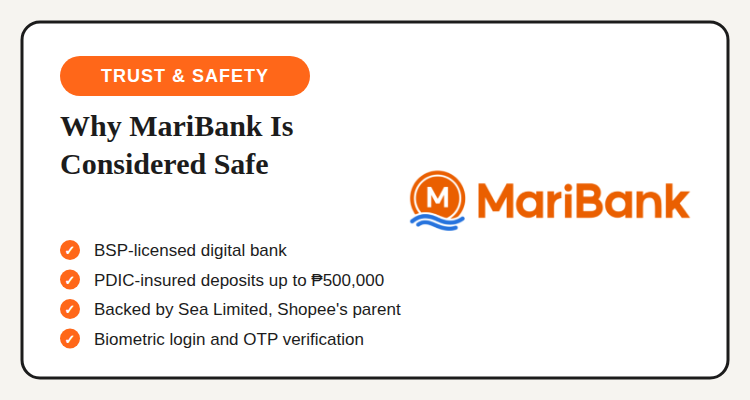
Two regulatory facts do most of the heavy lifting here. First, MariBank holds a digital banking license from the Bangko Sentral ng Pilipinas (BSP), the same category of license held by GoTyme and Maya. A digital bank license is not handed out casually; it requires capital requirements, governance standards, and ongoing supervision by the BSP, the same regulator that oversees BDO, BPI, and every other traditional bank in the country.
Second, deposits placed with MariBank are covered by the Philippine Deposit Insurance Corporation (PDIC) up to ₱500,000 per depositor. That's the exact same insurance ceiling that applies to a savings account at any major Philippine bank. If MariBank were ever to fail, which is not something any signal currently points to, PDIC insurance is the legal backstop that protects your balance up to that amount. Standard app-level security, biometric login, device binding, and OTP verification for sensitive actions, rounds out the picture. None of this is unique to MariBank; it's the baseline every licensed digital bank in the Philippines is required to meet, which is precisely the point: MariBank meets it.
MariBank vs. Unlicensed Lending Apps and Look-Alike Scams
This is where the confusion usually starts. The Philippines has seen a wave of predatory lending apps over the past few years, apps that harvest your contacts, charge hidden fees, and send harassment messages when payments are late. Some of these apps use bank-sounding names specifically to borrow credibility they haven't earned. MariBank is not in that category. It's a licensed depository institution, not a lending app, and it doesn't operate the way those apps do.
The confusion cuts both ways, though. A licensed brand name is also exactly what scammers like to imitate, because "MariBank" already carries trust that a made-up name wouldn't. A fake "MariBank Loan" app, a cloned login page, or a Facebook page using the MariBank logo without authorization can look convincing at a glance. The difference between the real bank and an impersonator usually comes down to a handful of concrete checks, which is worth walking through before you install anything.
Red Flags: How to Spot a Fake MariBank App or Scam
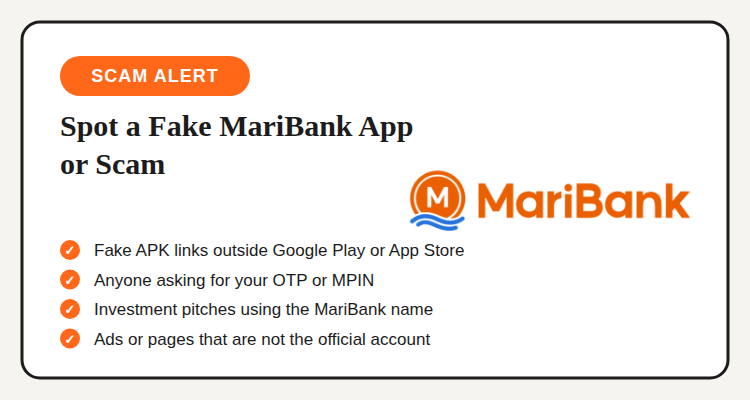
Filipino users searching this topic are frequently reacting to something specific, an ad, a message, an unfamiliar link, so here's what to actually watch for:
- Fake APK downloads. Only install MariBank from the official Google Play Store or Apple App Store. A file sent directly through Messenger, Viber, or a shortened link almost never leads anywhere good, an APK from outside the app store can be modified to steal your login the moment you type it in.
- Phishing links impersonating MariBank. Scam texts and emails often copy MariBank's branding and urge you to "verify your account" or "claim a bonus" through a link. Check the actual domain before clicking; anything that isn't maribank.ph is not MariBank.
- Requests for your OTP over chat. No legitimate bank employee, MariBank included, will ever ask you to read out or type in your one-time PIN, MPIN, or full card number in a chat window or phone call. This request alone is the single most reliable scam signal in Philippine digital banking.
- Unofficial ads and pages using the MariBank name. Scammers clone real ad creatives to run their own fake "MariBank" promotions on Facebook and TikTok. If an ad routes you somewhere other than the official app listing or maribank.ph, close it.
How to Verify You're on the Official MariBank App or Site
Before you enter your ID, selfie, or any personal detail, run through this quick check. On mobile, search "MariBank" directly in the Google Play Store or App Store rather than tapping a link from an ad, and confirm the developer name matches MariBank Philippines, Inc. before installing. On desktop or in a browser, type maribank.ph directly instead of clicking a link from a message or comment section.
If you're signing up with a referral code, you can also go through TipidNation's own verified MariBank link, which routes to the same official maribank.ph domain rather than a third-party redirect. For the account opening process itself, document requirements, and how long approval actually takes, our full MariBank account opening guide walks through every step so you know exactly what the legitimate signup flow looks like.
MariBank vs. Other Licensed Digital Banks
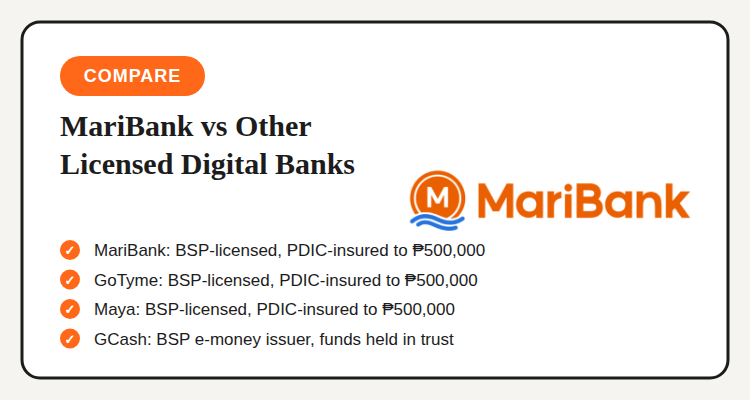
Legitimacy questions usually get easier once you compare regulatory status side by side instead of comparing app features. GCash is a BSP-licensed e-money issuer, not a bank, so its float is held in trust rather than covered by PDIC insurance the same way a deposit account is. MariBank, GoTyme, and Maya are all BSP-licensed digital banks, meaning each one carries that same ₱500,000 PDIC deposit insurance ceiling. None of that makes GCash unsafe, it's simply a different regulatory category doing a different job, which is exactly the kind of distinction worth understanding before you decide where to park savings versus where to send payments.
If you're weighing MariBank specifically against GoTyme and Maya on rates and card perks rather than just licensing, our MariBank vs GoTyme vs Maya comparison breaks down interest rates, fees, and card benefits across all three. And if you want the full rundown on MariCard's debit-credit hybrid feature and cashback structure, the MariCard review covers that in detail.
Bottom Line: Is MariBank Worth Trusting?
Based on its BSP digital banking license and PDIC-insured deposits up to ₱500,000, MariBank is a legitimate, regulated bank, not a lending app, not an unregulated fintech, and not the same risk category as the scam look-alikes that borrow its name. The actual risk for Filipino users isn't MariBank itself, it's the phishing links, fake APKs, and cloned ads that spread wherever a trusted brand gets popular enough to imitate. Stick to the official app store listing and maribank.ph, never share your OTP or MPIN with anyone, and you're dealing with the same category of institution as any major Philippine bank.
Ready to open a MariBank account?
See the current referral bonus and active promotions on the MariBank Philippines deals page.
View MariBank Promo Codes →