Why Both Programs Exist Now
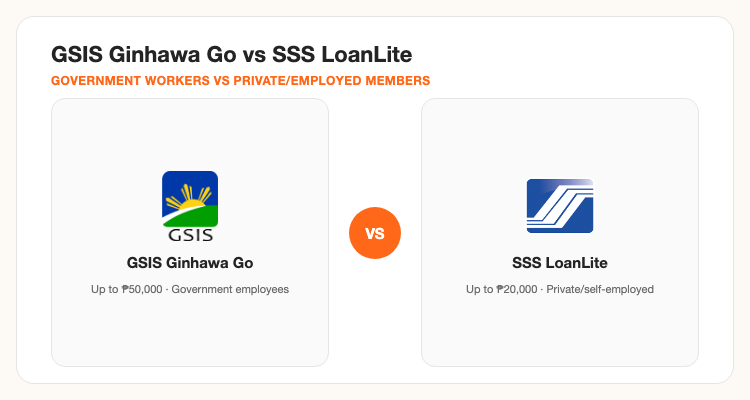
Both agencies are chasing the same problem from opposite sides: getting members out of informal 5-6 lending and into a regulated, app-based emergency loan with predictable interest. GSIS relaunched its short-term facility as Ginhawa Go in February 2026 (previously called Ginhawa Lite), and by late July 2026 had released more than ₱27.3 billion to over 463,000 government employees since the program's original October 2024 start. SSS answered with LoanLite, a micro-loan product it doesn't lend directly, instead partnering with digital banks starting with UnionDigital, with RCBC, Landbank, and UnionBank following through the rest of 2026. Both are explicitly framed as sss and gsis lending programs meant to give members a same-week, low-paperwork alternative to informal lenders.
GSIS Ginhawa Go: The Details
Ginhawa Go lends ₱1,000 up to ₱50,000 to GSIS members, active and retired government employees. Smaller loans (₱1,000, ₱2,000, ₱3,000, or ₱4,000) run on 30, 60, or 90-day terms. Larger loans (₱5,000 up to ₱50,000) stretch across 3, 6, 12, 18, or 24 months. Interest is fixed at 6% per annum for members with at least three years of paid premium contributions, and 7% per annum for newer members with less tenure. Every loan bundles Loan Redemption Insurance, which clears the remaining balance if the borrower dies before the loan is paid off, protecting the member's family from inheriting the debt.
Applications run exclusively through the GSIS Touch mobile app, there's no over-the-counter or My.SSS-style web portal option for this specific product. Approved proceeds land in the member's account within 24 to 36 hours, one of the faster turnarounds among Philippine government loan programs.
SSS LoanLite: The Details
SSS LoanLite (officially the SSS Micro Loan Program) caps out at ₱20,000 for employed, self-employed, voluntary, or OFW SSS members. Repayment terms are shorter and more flexible in structure, borrowers pick 15, 30, 60, or 90 days. Interest follows the prevailing initial SSS Salary Loan rate, which works out to roughly 8% per annum, about 0.67% a month. Eligibility requires at least 12 posted monthly contributions, no past-due short-term loans, no pending or settled final benefit claim, and no fraud record with SSS.
The catch with LoanLite: it isn't processed through My.SSS the way a regular SSS salary loan is. Members apply through a participating financial institution's own app, currently UnionDigital Bank, with RCBC and Landbank targeted for Q3 2026 and UnionBank of the Philippines for Q4 2026. Applicants enter their SSS number inside the partner app, review the maximum amount the system offers, choose the term, accept the disclosures, and submit.
Comparison Table
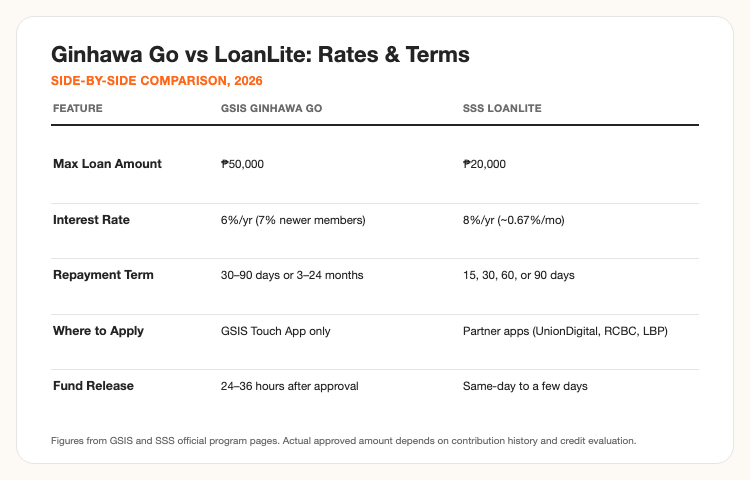
| Feature | GSIS Ginhawa Go | SSS LoanLite |
|---|---|---|
| Who qualifies | Government employees (GSIS members) | Employed, self-employed, voluntary, OFW SSS members |
| Max loan | ₱50,000 | ₱20,000 |
| Interest rate | 6%/yr (7% for newer members) | ~8%/yr (~0.67%/mo) |
| Term | 30–90 days (₱1K–₱4K) or 3–24 months (₱5K–₱50K) | 15, 30, 60, or 90 days |
| Apply via | GSIS Touch app only | Partner apps: UnionDigital Bank, RCBC, Landbank, UnionBank |
How to Apply, Step by Step
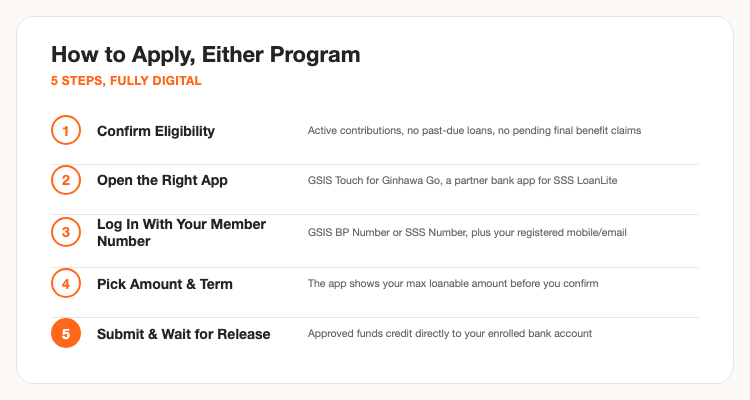
1. Confirm you're eligible. Check your posted contributions and make sure you have no past-due short-term loan or pending final benefit claim on either system.
2. Open the correct app. GSIS Touch for Ginhawa Go, or a participating bank's app (UnionDigital Bank is live now) for SSS LoanLite, there's no cross-over between the two.
3. Log in with your member number. Your GSIS BP Number or SSS Number, plus the mobile number or email tied to your account.
4. Pick your amount and term. The app displays your maximum loanable amount upfront based on your contribution history, before you commit to anything.
5. Submit and wait for release. Ginhawa Go typically disburses within 24 to 36 hours; SSS LoanLite timing depends on the partner bank processing the request.
Where These Fit Among Other SSS and GSIS Loans
LoanLite isn't SSS's only short-term option. The regular SSS Salary Loan allows a larger amount based on your Monthly Salary Credit but takes longer to process through My.SSS. The SSS Emergency Loan and SSS Calamity Loan activate only for members in declared disaster or emergency-affected areas, with their own separate eligibility rules (see our full SSS Calamity Loan guide for that program specifically). LoanLite's edge over all of them is speed and a fully digital, no-branch-visit process, in exchange for a lower ceiling.
On the GSIS side, Ginhawa Go isn't the only mobile lending product either. GSIS also runs the Ginhawa Solar Energy Loan (GSEL), commonly searched as the "GSIS solar loan," which lends up to ₱500,000 at 5% annual interest over 60 months specifically to cover solar panel equipment and installation. GSIS solar loan requirements include at least three years of service, at least one month of contributions posted within the last six months, no pending administrative or criminal case, and no defaulted GSIS loan aside from an existing housing loan. Like Ginhawa Go, it's applied for exclusively through GSIS Touch. A separate Ginhawa Bike and E-Mobility Loan also launched in 2026 for members wanting to finance a bicycle or e-mobility device.
Which One Should You Actually Use
If you're a government employee, Ginhawa Go is close to a no-brainer for a short-term cash gap, the rate is lower, the ceiling is higher, and the GSIS Touch app is the only step standing between you and the money. The main trade-off is channel lock-in, if GSIS Touch is down or you don't have the app set up yet, there's no over-the-counter fallback for this specific product.
For private-sector and self-employed SSS members, LoanLite is genuinely useful for a smaller, short-notice expense, think a medical co-pay, an unexpected repair, or bridging a week between paychecks, rather than a larger planned cost. Because it currently rolls out through a limited set of partner banks, whether it's available to you today depends on whether you already bank with (or are willing to open an account with) UnionDigital, RCBC, Landbank, or UnionBank. If your bank isn't yet on that list, the regular SSS Salary Loan through My.SSS remains the more universally accessible option while LoanLite's partner network keeps expanding through the rest of 2026.
Either way, treat both programs the same way you'd treat any emergency loan: borrow only what the actual expense requires, not the maximum the app offers, and confirm the exact repayment schedule before tapping submit. A 6% or 8% annual rate is cheap relative to informal lending, but it still isn't free money, and a missed payment on either program can block you from future SSS or GSIS loans until it's settled.
Frequently Asked Questions
Sources: GSIS's official Ginhawa Go page, SSS's official LoanLite page, and news reporting on the ₱27.3B Ginhawa Go disbursement milestone and SSS's LoanLite partner bank rollout. Logos used for identification purposes only. This article is general educational information, not official GSIS or SSS guidance, confirm current rates, requirements, and available partner apps directly before applying.