What Actually Counts as a "Hidden Fee" Here
Not every fee you dislike is hidden. A hidden fee under Philippine lending law has a specific meaning: a charge that was never itemized on the Disclosure Statement you received and signed before the loan was released. Republic Act 3765, the Truth in Lending Act, requires every lender, bank or non-bank, to show you the principal amount, the nominal and effective interest rates, the full peso amount of finance charges, documentary stamp tax, and any processing or service fee, in writing, before you're bound to the loan.
If a fee you never saw on that disclosure later appears as a deduction from your disbursed amount, or as a surprise line on your statement of account, that specific charge is a disclosure violation on its own, separate from whether the rate itself is high or low. Licensed lending and financing companies that Finbro routes applications to also fall under SEC Memorandum Circular No. 3, Series of 2022, which mirrors BSP Circular No. 1133 and caps the nominal interest rate, processing fee, and total cost of credit on small loans of ₱10,000 or less with a term of four months or less. A fee that pushes your total cost past that ceiling is independently actionable even if the lender did write it down somewhere.
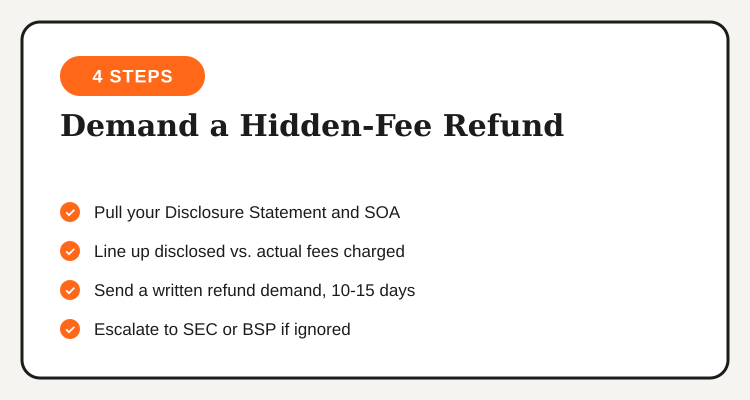
Step 1: Pull Your Documents and Line Up the Numbers
Before you write a single message to the lender, gather everything that shows what you agreed to versus what actually happened to your money. This matters because a refund demand backed by exact figures gets answered far faster than a vague complaint about "extra charges."
| Document to Pull | What It Proves |
|---|---|
| The signed Disclosure Statement or loan agreement | The exact fees you agreed to, nothing more |
| Screenshot of the amount applied for in the app | Your starting request before any deduction |
| Screenshot or bank record of the amount actually disbursed | The gap, in pesos, between what was promised and what landed |
| Your statement of account (SOA) from the lender | Shows any fee applied after disbursement, not just at release |
| Any in-app fee breakdown shown before you tapped "accept" | Evidence of what was displayed to you at the moment of consent |
Line these up side by side. A ₱20,000 loan with a disclosed ₱600 processing fee that actually arrives as ₱19,000 in your account, an ₱800 gap beyond the disclosed amount, is the kind of exact discrepancy a lender cannot easily argue around.
Step 2: Send a Written Refund Demand to the Lender First
Go to the lender directly before involving a regulator. Email, not chat, since chat messages inside an app are easy for a lender to claim were never received or were misread. Your demand should name the exact fee, cite the amount disclosed versus the amount charged, reference the Truth in Lending Act by name, and set a deadline, ten to fifteen business days is standard, for a written response.
Keep the tone factual rather than confrontational. State the discrepancy, attach your documents, and ask for the refund of the specific undisclosed amount to be credited back or applied against your outstanding balance. A paper trail that shows you gave the lender a fair, documented chance to resolve this on its own strengthens any complaint you file afterward.
Step 3: Escalate to the Right Regulator If the Lender Stalls
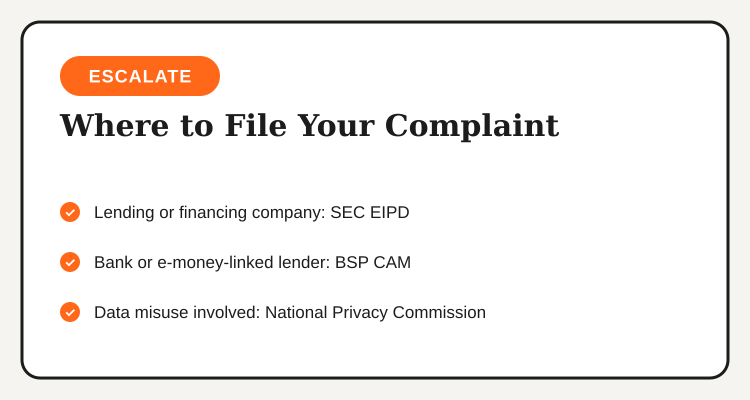
If the deadline passes with no refund and no reasonable explanation, the complaint moves to a regulator. Which one depends on what kind of entity you borrowed from.
| Lender Type | File With | What to Cite |
|---|---|---|
| Licensed lending or financing company | SEC Enforcement and Investor Protection Department | RA 3765, RA 9474, SEC Memorandum Circular No. 3-2022 |
| A bank or an e-money-linked lending product | BSP Consumer Assistance Mechanism | RA 3765, BSP Circular No. 1133, RA 11765 |
| Any entity, if the issue also involves data misuse | National Privacy Commission | Data Privacy Act, alongside the SEC or BSP complaint |
Attach the same documents from Step 1, plus your written demand and the lender's response (or proof you received none). Republic Act 11765, the Financial Products and Services Consumer Protection Act, specifically empowers the SEC and BSP to order a regulated lender to restitute an affected borrower directly, not just pay a fine to the government, which is what actually gets your money back rather than just penalizing the company.
What Happens After You File
Filing with the SEC or BSP doesn't mean your money shows up the next day. After you submit your complaint and supporting documents, the regulator typically requires the lender to respond within a set window, often similar to the ten to fifteen business days you already gave them in your initial demand. If the lender's explanation doesn't hold up, the case moves into a review that can end in a directive to refund the specific amount, a fine against the company, or, for repeat and serious violations, a suspension or revocation of the lender's Certificate of Authority to operate.
Expect this to take weeks rather than days for a straightforward case, and longer if the lender disputes the facts. That's a reasonable tradeoff for a process that doesn't require a lawyer or a filing fee on your end. Keep paying according to the original disclosed terms while the complaint is pending, if you're still able to, since the dispute over the fee and your underlying obligation to repay the principal are treated as separate matters. Disputing a fee doesn't pause the loan itself.
Where Finbro Fits Into This
Finbro itself is a comparison platform, it lines up several licensed lenders side by side so you can weigh terms before applying, but it does not extend the loan, set the fees, or collect your repayments. That means the refund demand and any regulatory complaint go to the specific lender, not to Finbro. Still, flag the lender to Finbro's support team once you've started the process. Marketplaces that route applications to partner lenders have a direct interest in knowing when one of those partners is generating complaints, and can help you find an alternative licensed lender to compare while your dispute with the first one is still open.
It's worth being precise about this distinction when you write your demand letter or your regulatory complaint. Naming Finbro as the party responsible for the fee, when the actual lending relationship sits with its partner lender, slows down a regulator's review, since the agency has to first sort out which entity the complaint is even against. Name the lender's registered legal name, the one on your Disclosure Statement, as the respondent, and mention how you found that lender (through a comparison on Finbro) only as background context for how the loan originated.
Preventing This on Your Next Loan
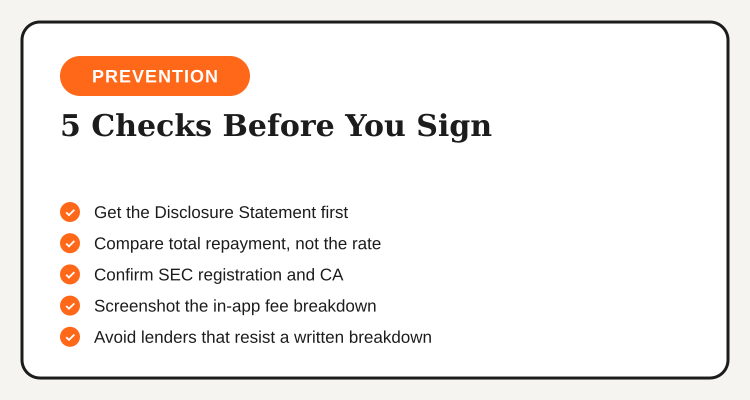
The habit that avoids this entire situation is simple, and it is the same habit a marketplace model is built for: comparing the total repayment figure, not the advertised rate, across more than one licensed lender before accepting any single offer.
- Request the Disclosure Statement before you accept, not after. A legitimate lender can show you this document ahead of final consent.
- Add up the full repayment amount, principal plus every listed fee, and compare it against at least one other lender quote.
- Confirm the lender's SEC registration and Certificate of Authority on the SEC's public list before applying.
- Screenshot the in-app fee breakdown at the moment you apply, before any later screen can show a different number.
- Be wary of any lender that resists giving a written breakdown before you sign, that resistance is itself a warning sign.
Running that comparison through Finbro's loan marketplace before you commit to one lender is the most practical way to catch a fee gap before it ever reaches your bank account, rather than disputing it afterward.
This guide is informational only and not personalized legal advice. Actual fees, disclosure practices, and regulatory outcomes depend on the specific lender and your individual loan terms, so confirm current details directly with the lender, the SEC, or the BSP before filing a formal complaint.
See Finbro's current roster of licensed partner lenders and compare total repayment figures side by side.
Compare Lenders on Finbro →