Who's Actually Winning the Philippine EV Market
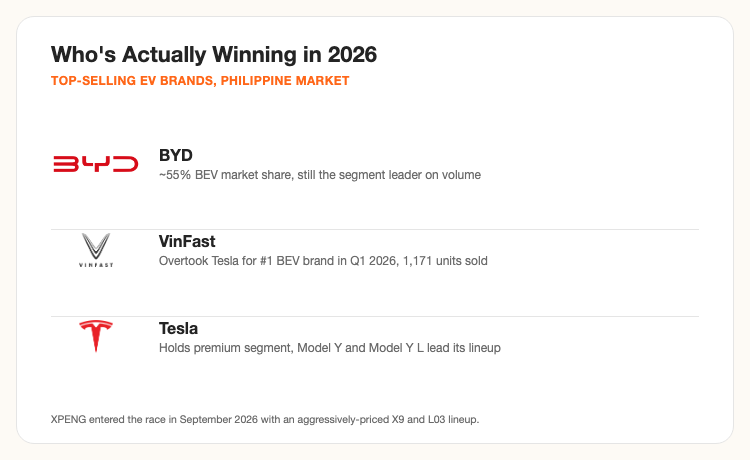
The scoreboard shifted hard in 2026. BYD still leads on total volume with roughly 55% BEV market share after growing 67.2% year-on-year, but VinFast pulled off the bigger story, overtaking Tesla for the #1 best-selling battery-electric brand specifically in Q1 2026, selling 1,171 units against just 335 in the same period the year before, a jump north of 5,500%. VinFast now holds more than 50% BEV share among CAMPI and TMA-reporting brands. Tesla holds a solid #3, concentrated in the premium segment through the Model Y (from ₱2.369M) and the newer six-seat Model Y L (from ₱2.849M).
Brand-by-Brand Breakdown
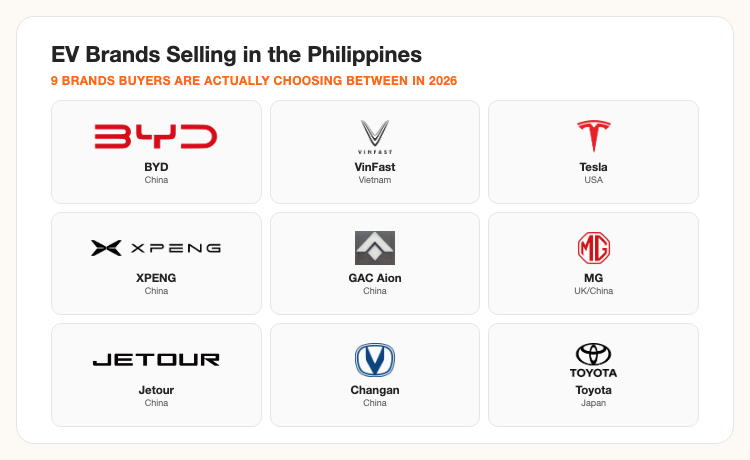
BYD (China) covers the widest price range of any brand here: the Dolphin hatchback at ₱1.398M, the Atto 3 crossover from ₱1.638M to ₱1.848M, the Sealion 6 DM-i plug-in hybrid at ₱1.548M, and the Seal sedan from ₱2.098M to ₱2.648M. Ayala Corporation is BYD's official Philippine distributor, a signal of how seriously local conglomerates are treating this brand.
VinFast (Vietnam) plays hardest at the entry level, the VF3 city car starts at ₱745,000 with a battery-subscription option to lower the upfront price further, while the VF5 SUV starts at ₱1.099M. VinFast backs its cars with a notably long 10-year vehicle warranty and free charging at V-Green stations for the first 3 years, a strong pitch for first-time EV buyers wary of long-term costs.
Tesla (USA) sells purely in the premium tier, no sub-₱2M model, but comes with Supercharger network access and Tesla's own software ecosystem, appealing to buyers who want the brand cachet and tech-first experience over the lowest sticker price.
XPENG (China) is the newest name on this list. Officially launched in September 2026, it brought a six-variant lineup across the X9 electric MPV (three-row, priced ₱3.858M to ₱4.058M) and the L03 crossover/sedan (from ₱1.548M, including a range-extended EV variant), positioned as aggressively-priced and tech-forward. First deliveries are expected in Q4 2026.
Jetour (China, a Chery sub-brand) leans into affordability, the Ice Cream EV hatchback at ₱699,000 is one of the cheapest EVs sold in the country, while its PHEV lineup (T1, T2 Lightning i-DM, G700) runs from ₱1.898M up to ₱4.488M for the flagship G700.
Changan (China) keeps it simple with the Lumin, a compact city EV priced ₱699,000 to ₱799,000, going head-to-head with Jetour's Ice Cream at the entry tier.
GAC's Aion brand (China, under GAC International Philippines since January 2026) offers the Aion V SUV in Elite (₱1.498M) and Premium (₱1.698M) trims, the Hyptec HT flagship from ₱2.26M to ₱2.58M, and the newer Aion UT hatchback with a 400km range on a 44.13kWh LFP battery.
MG (UK-origin brand, China-owned by SAIC) offers the ZS EV from ₱1.839M and the MG4 EV from ₱1.469M up to ₱2.001M for the sportier XPower variant, with the brand running frequent promotional cash discounts, sometimes up to ₱400,000 off on select models.
Toyota (Japan) is the odd one out, its Philippine EV push is still small next to its hybrid dominance. The bZ4X, Toyota's first mainstream BEV here, launched at ₱2.699M with a 73.11kWh battery and 570km range, free home and portable AC chargers included. Toyota's far bigger local footprint is still its HEV lineup (Corolla Cross, RAV4, and others), which doesn't need charging infrastructure at all, a meaningfully different pitch than every brand above it.
BEV vs HEV vs PHEV: Pick the Powertrain First
Before comparing brands, decide what kind of electrified car actually fits your driving pattern.
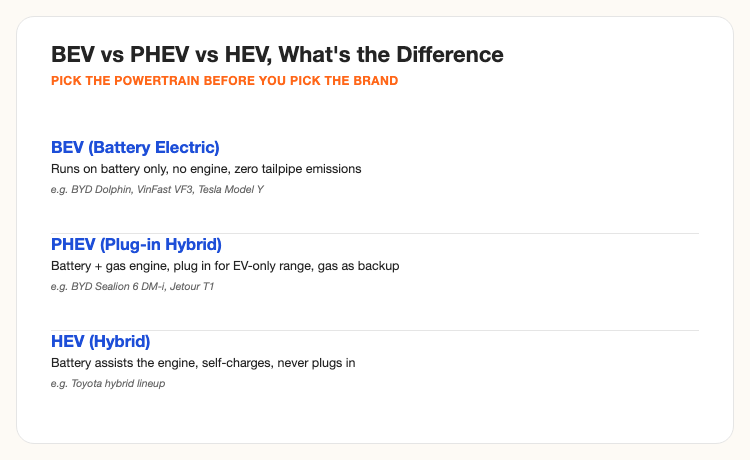
A BEV (battery electric, no engine at all) fits a buyer with home or condo charging access and mostly city or short-provincial driving. A PHEV (plug-in hybrid) suits someone who wants EV-only range for daily errands but doesn't want charging anxiety on a long Baguio or Batangas trip, the gas engine just takes over. An HEV (regular hybrid, like most of Toyota's lineup) never plugs in and self-charges through braking and the engine, the lowest-commitment option if you're not ready to deal with charging logistics at all but still want better fuel economy than a pure gas car.
What Reviews and Owners Are Actually Saying
Beyond the sales numbers, sentiment across Philippine car forums, social media, and owner interviews points to a few consistent themes. VinFast owners quoted in local coverage highlight the practicality angle, one VF6 owner noted being able to "drive it and still look cool" while praising cabin space for passengers and its fit for daily driving, and another described pride in "an Asian brand like VinFast competing head-on with American and European automakers." BYD draws consistent praise for build quality and feature-per-peso value relative to its price tier, a common theme in Philippine car-buyer Facebook groups and forums. Common concerns across nearly every Chinese and Vietnamese brand center on two things: long-term resale value, since these brands are still building a multi-year track record locally, and charging infrastructure outside Metro Manila, which remains thinner than in NCR. Tesla and Toyota, as more globally established names, draw fewer resale-value questions but face the opposite criticism, higher entry prices relative to newer competitors offering similar specs for less.
Big Local Moves: EO 121, Ayala, and SM
President Marcos signed Executive Order No. 121 on July 29, 2026, creating the Electric Vehicle Incentive Strategy (EVIS), a fiscal incentive program with a ceiling of ₱60 billion (up to ₱15 billion per enrolled model) meant to pull EV manufacturers into building locally, not just importing. The goal: narrow the price gap between EVs and conventional cars, create manufacturing jobs, and position the Philippines as a regional EV production hub over an 8-year horizon, with the Board of Investments overseeing implementation.
On the corporate side, Ayala Corporation made its EV pivot official, becoming BYD's Philippine distributor while winding down decades-long Honda and Volkswagen partnerships, backed by a $100-million ADB financing deal specifically for EV charging infrastructure and commercial EV procurement. SM Group, through BDO Unibank, is providing financial backing to Vingroup's Green GSM electric ride-hailing service, which started Philippine operations in mid-2026, a bet on EV adoption from the fleet and ride-hailing side rather than direct retail sales.
Which Brand Actually Fits Your Situation
There's no single "best" EV brand in the Philippines right now, only a better fit for a specific budget and use case. Tightest budget, city-only driving: the VinFast VF3, Jetour Ice Cream EV, or Changan Lumin, all under ₱800,000, cover basic commuting with the lowest entry cost. Value-focused family SUV: the BYD Atto 3 or GAC Aion V sit in the ₱1.5M to ₱1.8M range with real cargo space and a growing local parts network. Want a plug-in hybrid safety net for provincial trips: the BYD Sealion 6 DM-i or a Jetour PHEV variant removes range anxiety entirely. Premium buyers who want the most established brand: Tesla or the Toyota bZ4X, at a real price premium, but with the longest global track record and strongest resale confidence among buyers who prioritize that. Early adopters chasing the newest tech at an aggressive price: XPENG's September 2026 launch is worth a serious look, provided you're comfortable being an early buyer on a brand-new local service network.
Financing an EV: What Banks Are Actually Offering
Most EV buyers finance rather than pay cash, and rates vary more between banks than most shoppers expect. Standard auto loan rates from BDO start around 6.88% per annum, BPI starts around 6.5%, both typically requiring a 20% minimum down payment and a gross monthly income of at least ₱25,000 to qualify. Several banks now run EV-specific promotional rates meaningfully lower than their standard auto loan: RCBC has offered a 5.35% p.a. promo for EVs, Metrobank around 5.49%, and Landbank around 6%, all below their equivalent gas-car rates.
Beyond bank financing, brand-specific in-house financing (offered directly by BYD, VinFast, and others through their dealer network) sometimes beats bank rates on shorter terms, but usually with a higher rate on longer terms, run the actual total cost on both options rather than assuming either is automatically cheaper. A lower advertised rate with a shorter maximum term can still cost more per month than a slightly higher rate stretched over a longer one, compare the full amortization schedule, not just the headline percentage.
The Actual Buying Process & What to Check
Buying an EV in the Philippines follows the same broad steps as any car purchase, with a few EV-specific checks layered in.
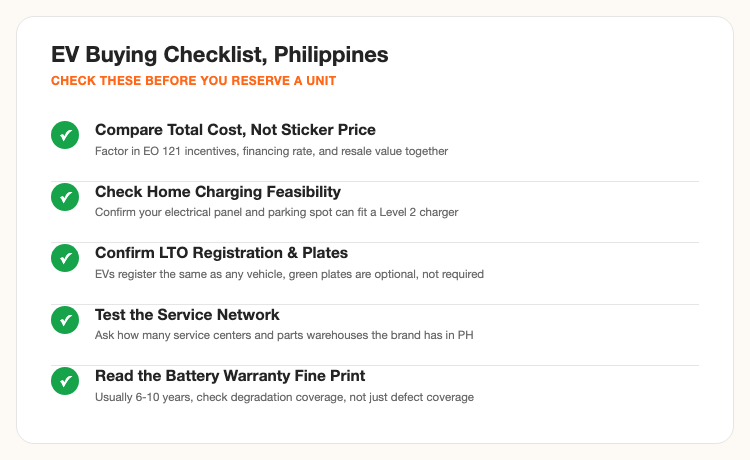
Compare total cost, not the sticker price. Factor in financing rates, any applicable incentive under EO 121 as it rolls out, and realistic resale value for that specific brand's track record in the Philippines.
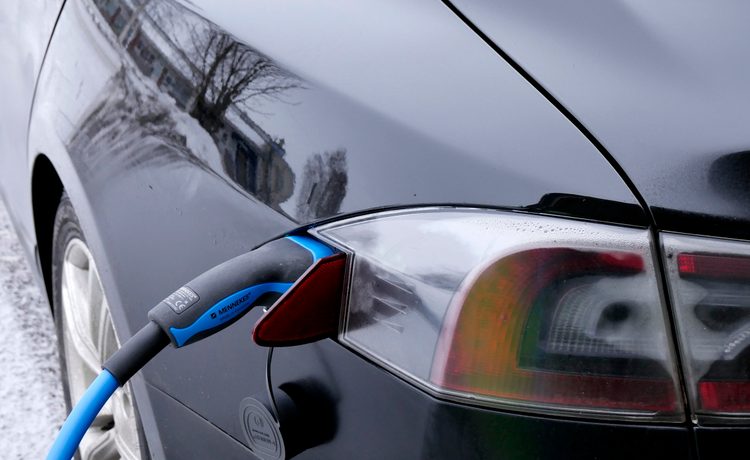
Check home charging feasibility before you reserve. Confirm your electrical panel can support a Level 2 charger and that your parking spot (house garage, condo slot) actually allows an installation, condo buildings especially can restrict this.
LTO registration works the same as any vehicle, EVs don't need special plates, the green EV plate option is cosmetic, not mandatory. Test the service network before committing, ask the dealer directly how many service centers and parts warehouses exist nationwide, this matters far more once your unit is past warranty. Finally, read the battery warranty terms closely, most brands cover 6 to 10 years, but check whether that covers capacity degradation specifically, not just manufacturing defects, the two are often covered differently in the fine print.
Frequently Asked Questions
Sources: CAMPI/TMA sales data as reported by BusinessWorld, TopGear.ph, and GulfNews; the Official Gazette on Executive Order No. 121; Department of Finance and DOE statements on EVIS; brand pricing from official Philippine dealer sites and Carmudi, Zigwheels, AutoDeal, and TopGear.ph listings as of late September 2026; VinFast owner quotes via Vingroup media coverage. EV brand logos used for identification purposes, BYD, VinFast, MG, Toyota, Jetour, Changan, and XPENG logos via Wikimedia Commons (public domain, simple marks); Changan logo CC BY-SA; GAC Aion emblem photo CC BY-SA 4.0. Prices and incentive terms change frequently, confirm current figures with the dealer or BOI before purchasing.