For diminishing balance or flat rate loans with fees, you can also use our free loan amortization calculator.
Personal Loan Calculator
Pick a bank to load its starting monthly add-on rate, or choose "Custom Rate" to test your own quoted rate. This estimates the standard Philippine bank add-on-rate formula, actual approved rate, fees, and total cost depend on your credit evaluation.
Estimate only, excludes one-time processing fee (commonly ₱1,500) and Documentary Stamp Tax (0.75% on loans above ₱250,000). Confirm the exact Disclosure Statement with your bank before signing.
Personal Loan Rates & Terms by Bank
Rates below are each bank's own advertised starting monthly add-on rate as of late 2026. The rate you're actually offered depends on your income, credit history, and relationship with the bank, treat these as a starting comparison point, not a guaranteed quote.
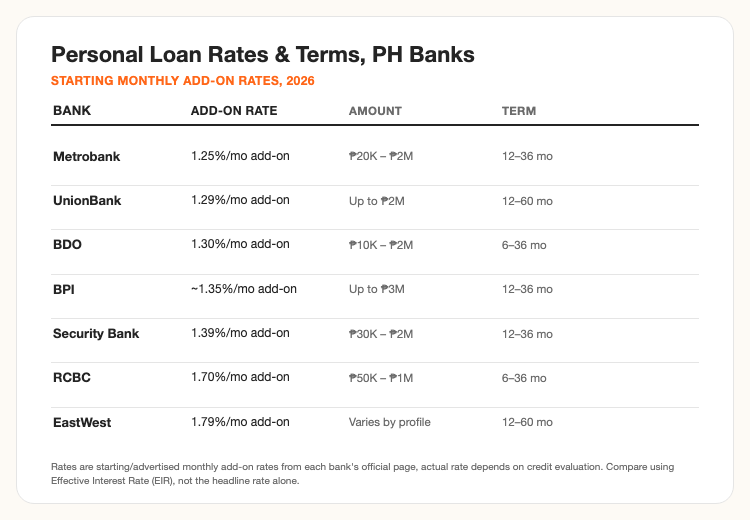
| Bank | Monthly Add-on Rate | Loan Amount | Term | Min. Income |
|---|---|---|---|---|
| Metrobank | 1.25% (APR ~30.5–33.3%) | ₱20,000 – ₱2,000,000 | 12–36 months | ₱250,000/year |
| UnionBank | 1.29% (ACR ~26.9%) | Up to ₱2,000,000 | 12–60 months | Varies by profile |
| BDO | 1.30% (from 0.98% for qualified profiles) | ₱10,000 – ₱2,000,000 | 6–36 months | Varies by profile |
| BPI | ~1.35% (max ACR 28.67%) | Up to ₱3,000,000 (up to 3x monthly income) | 12–36 months | Varies by profile |
| Security Bank | 1.39% (APR from 29.48%) | ₱30,000 – ₱2,000,000 | 12–36 months | No credit card required |
| RCBC | 1.70% | ₱50,000 – ₱1,000,000 | 6, 18, 24, 36 months | Varies by profile |
| EastWest | 1.79% (illustrative) | Varies by profile | 12, 18, 24, 36, 48, 60 months | Varies by profile |
Both BDO and Metrobank charge a one-time ₱1,500 disbursement/processing fee, plus Documentary Stamp Tax at 0.75% on loans above ₱250,000, fees most banks apply similarly. BPI's own worked example shows a ₱20,000 loan over 12 months totaling ₱23,240, about ₱1,937 a month, useful as a sanity check against the calculator above.
Personal Loan Alternatives Worth Comparing
A traditional bank personal loan isn't the only option, and it isn't always the fastest or cheapest one for every situation.
Digital bank loans (Maya, Tonik, CIMB). These approve faster with less paperwork, useful for smaller, shorter-term needs. Tonik's Credit Builder Loan, for example, goes up to around ₱50,000 over 6 to 12 months with a published monthly add-on rate around 4.18% to 4.26%, notably higher than a traditional bank rate, the trade-off is speed and accessibility over cost.
SSS or Pag-IBIG salary/calamity loans. For SSS or Pag-IBIG members, a salary loan against your own contributions typically carries a lower rate than any bank personal loan, worth checking eligibility first if you're already a contributing member.
Credit card installment or cash advance. A card's 0% installment promo on a specific retail purchase can beat a personal loan for that purchase, but a cash advance carries a high finance charge from the moment you withdraw, it's rarely cheaper than a personal loan for actual cash needs.
Avoid unregistered "5-6" or informal lenders. Informal lending (colloquially "5-6") charges effective rates far above any licensed bank or SEC-registered online lender, and carries none of the consumer protections a regulated lender provides. If a lender isn't listed with the SEC or BSP, that's a red flag regardless of how convenient the offer sounds.
How to Apply for a Personal Loan
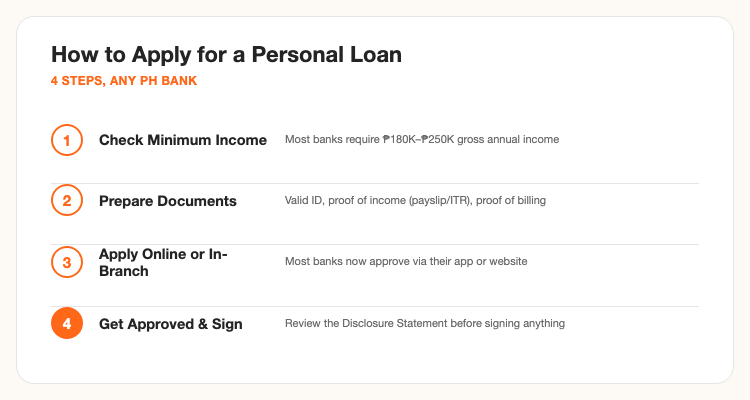
1. Check the minimum income requirement. Most banks set this between ₱180,000 and ₱250,000 gross annual income, confirm before applying to avoid an automatic decline.
2. Prepare your documents. A valid government ID, proof of income (payslip, Certificate of Employment, or ITR for self-employed applicants), and proof of billing for your current address cover most banks' base requirements.
3. Apply online or in-branch. Most major banks now accept personal loan applications through their app or website, with in-branch applications still available for those who prefer it or need help with documentation.
4. Get approved and read the Disclosure Statement carefully. Before signing, this document legally has to show the Effective Interest Rate, all fees, and the full payment schedule, read it against what the sales officer verbally quoted you.
Frequently Asked Questions
Sources: official rate and product pages of BDO, BPI, UnionBank, Metrobank, EastWest, Security Bank, and RCBC as of late September 2026, cross-checked with Moneymax.ph. Bank logos used for identification purposes only. This calculator is an estimate for general educational use, not a loan offer, confirm your actual rate and total cost with the bank's official Disclosure Statement before signing.