The Two Layers of Car Insurance in the Philippines
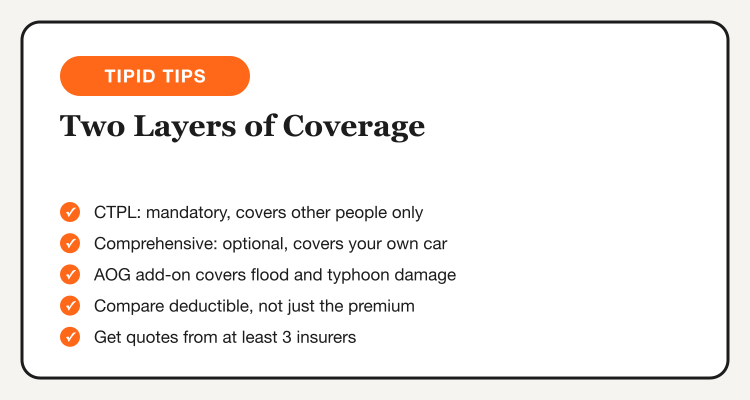
Car insurance here is not one product. It is two separate layers that answer two separate questions: who pays if you hurt someone else, and who pays if your own car gets damaged or stolen. Understanding which layer you are looking at prevents the most common mistake buyers make, which is assuming a cheap CTPL sticker means the car itself is protected.
CTPL is the mandatory layer. Every registered vehicle needs it to pass LTO registration, and the premium is set by regulation rather than shopped between insurers. It exists to guarantee that a third party injured in an accident has some minimum recourse, even if the at-fault driver has no other assets.
Comprehensive is the optional layer, and it is where insurers actually compete on price and terms. It covers your own vehicle against collision, theft, fire, and (with an add-on) flood and other weather events. If you paid cash for your car and never plan to drive it again after a bad accident, you could legally skip comprehensive. Almost nobody in that position actually wants to, because the cost of one collision repair or a stolen vehicle usually dwarfs years of premiums.
| Coverage type | Mandatory? | Protects | Common exclusion |
|---|---|---|---|
| CTPL | Yes, for LTO registration | Third parties you injure or affect | Your own car and your own injuries |
| Comprehensive (own damage) | No, unless financed | Collision, fire, theft on your car | Flood and typhoon, unless AOG is added |
| Acts of God (AOG) add-on | No, optional add-on | Flood, typhoon, earthquake, landslide | Gradual water damage, neglect |
How Insurers Price Comprehensive Coverage
Comprehensive premiums are built around the insured value of your car, which is roughly its current market value rather than the price you originally paid. A newer or higher-value car costs more to insure in peso terms even at the same rate, simply because there is more value at risk. Insurers also weigh the car's model and theft profile, since some vehicles are stolen or stripped for parts far more often than others.
Your own driving history matters too, though its weight differs by insurer. A clean claims record over several years can bring the renewal quote down, while a recent claim, especially a total loss claim, tends to push it up. This is one more reason to compare providers at renewal rather than auto-renewing with whoever insured you last year: a claim history that one insurer prices conservatively might be priced more favorably by another.
Add-ons change the total noticeably. AOG coverage, a lower deductible, roadside assistance, and personal accident coverage for the driver and passengers each carry their own cost. Because rates and add-on pricing shift between insurers and over time, treat any specific percentage you see online, including in comparison articles, as a starting point for your own quote request rather than a number to budget against directly.
Where you keep and park the car also enters the calculation, even if it is not always a visible line on the quote. A vehicle parked on the street overnight in a dense urban area typically carries more theft risk than one parked in a gated subdivision or a guarded building, and some insurers factor that into underwriting even without asking directly. If you drive for work, using a personal vehicle for ride-hailing or delivery, say so upfront, since an unreported commercial use can complicate or void a claim later.
Reading a Comprehensive Quote Line by Line
Two quotes with the same headline premium can cover very different amounts of risk. The deductible, sometimes called the participation amount, is what you pay out of pocket before the insurer covers the rest of a claim. A lower headline premium paired with a high deductible can end up costing more at claim time than a slightly higher premium with a low deductible, depending on how often you actually file claims.
Check whether the quote includes acts of God coverage by default or as a separate line item, since this is the single most commonly missed gap in the Philippines given how often flooding closes roads. Also check the depreciation schedule for parts, since some policies pay a lower percentage of a part's cost as the car ages, which affects your real payout years into the policy.
Comparing car insurance quotes side by side is worth the extra half hour it takes, because the differences rarely show up in the sticker price alone. If you are also weighing how to finance the car itself, our guide to comparing personal loans in the Philippines covers the borrowing side of a vehicle purchase, including how lenders assess indicative rate ranges.
Also look at how the insurer defines a total loss. Most policies set a threshold, often expressed as a percentage of the insured value, above which a damaged car is declared a total loss rather than repaired. If your car is declared a total loss, the payout is based on the insured value at the time of the accident, not what you originally paid for the vehicle, which is another reason to keep your declared value updated at each renewal rather than letting it run on an outdated figure.
Filing a Claim Without Losing Time
Document everything at the scene before the vehicles are moved, if it is safe to do so. Photos of both cars, the road position, and any visible damage protect you if the other party's account of the accident later differs from yours. Get the other driver's name, plate number, and insurer if the accident involves another vehicle.
Report the incident to your insurer within the window stated in your policy, which is often a short number of days rather than weeks. A late report can complicate or delay a claim even when the accident itself is not in dispute. Keep the police report or barangay blotter if one was filed, since insurers frequently require it for larger claims.
Ask your insurer for a list of accredited repair shops before you need one, not after. Repairs at an accredited shop are usually processed faster and with less back and forth over parts pricing than a claim routed through a shop of your own choosing. If the accident involves another driver and a dispute over fault, both insurers typically coordinate through their own adjusters rather than leaving the two drivers to negotiate directly, which is one advantage of having comprehensive coverage even on a car that was clearly not at fault.
Your 5-Step Comparison Process
- Get your car's current insured value. Ask each insurer to quote against the same value so the premiums are actually comparable.
- Request quotes from at least three insurers. Include the exact same add-ons in every request, especially AOG.
- Compare the deductible, not just the premium. A cheaper premium with a high deductible is not automatically the better deal.
- Confirm the claims process and turnaround. Ask how long a typical collision claim takes to settle and whether the insurer has accredited repair shops near you.
- Verify the insurer is licensed. Cross-check the Insurance Commission's list before paying any premium to a provider you have not used before.
Frequently Overlooked Costs
Registration renewal, CTPL, and comprehensive premiums are the visible costs of owning a car, but a few smaller items catch new buyers off guard. Insurers sometimes charge a documentary stamp tax and a small local government tax on top of the quoted premium, which shows up on the official receipt rather than the initial quote. Ask for the all-in total, not just the base premium, before comparing across providers.
If you are financing the vehicle, confirm whether the bank requires you to buy comprehensive coverage through its own accredited insurer or whether you can choose your own, since being locked into a single bank-preferred insurer removes your ability to shop the market for the term of the loan. This detail is usually buried in the loan agreement rather than the insurance quote, so check it before signing.
None of this is personalized financial advice. Car insurance needs vary with how you drive, where you park, and what the vehicle is worth, so treat this guide as a starting framework and confirm current terms directly with each insurer before you buy. If you are also comparing how to fund a down payment or vehicle purchase through a digital wallet, GCash's savings and payment features are worth checking alongside your bank options.
The Short Version
CTPL keeps you legal. Comprehensive protects the car you actually paid for, and the add-ons you choose, especially Acts of God coverage, determine how much of that protection survives a bad flood season. Compare at least three quotes against the same insured value and the same add-ons, read the deductible as closely as the premium, and confirm the insurer's license before you commit.